IRS Letter

Humor Section (cont)

The IRS actually received the following letter:

Gentlemen:

Enclosed you will find a check for $150.  I cheated on my income tax return last year and have not been able to sleep ever since.  If I still have trouble sleeping, I will send you the rest.

Sincerely,

John Smith

A man went to the doctor and said: “I’ve been misbehaving lately, Doc, and my conscience is troubling me.”

The doctor said, “You want me to give you something that will strengthen your willpower?”

“Well no,” said the man, “I was hoping you could give me something that would weaken my conscience.”

You may recall from history that prisoners were sometimes made galley slaves — chained to the oars where they would serve their time in back-breaking rigor.

One day, a certain duke walked through the area where the prisoners were chained to the oars and began to ask the men what their offences were.  Each one excused himself for various reasons —

One claimed false accusations.  Another claimed the judge had been bribed.  All had an excuse

Finally, the duke asked a man his offense.  The prisoner responded: “I am here because I am guilty of stealing.  I was hungry and I stole money to buy food.”

The duke was aghast.  He said to the man, “You rogue!  What are you doing here among so many innocent men?  Get out of their company before you corrupt them.”

That man was then set free while the rest of the prisoners served out their time, chained to the oars.

Two men who lived in a small village got into a terrible dispute that they could not resolve. So they decided to talk to the town sage – the old wise man that everyone respected. The first man went to the sage’s home and told his version of what happened. When he finished, the sage said, “You’re absolutely right.”

The next night, the second man called on the sage and told his side of the story. The sage responded, “You’re absolutely right.”

Afterward, the sage’s wife scolded her husband. “Those men told you two different stories and you told them they were absolutely right. That’s impossible — they can’t both be absolutely right.”

The sage turned to his wife and said, “You’re absolutely right.”

There was a very cautious man
Who never laughed or played;
He never risked, he never tried,
He never sang or prayed.

And when he one day passed away
His insurance was denied;
For since he never really lived,
They claimed he never died!

The manager of a minor league baseball team was so disgusted with the center fielder’s performance that he ordered him to the dugout and assumed the position himself.  The first ball that came into center field took a bad hop and hit the manager in the mouth.  The next one was a high fly ball, which he lost in the glare of the sun—until it bounced off his forehead.  The third was a hard line drive that he charged with outstretched arms; unfortunately, it flew between his hands and smacked his eye.

Furious, he ran back to the dugout, grabbed the center fielder by the uniform, and shouted, “You idiot!  You’ve got the center field so messed up that even I can’t do a thing with it!”

One critic said he had gone to many churches and heard the preacher say: “Don’t try to impress God with your works”

“Don’t attempt to please God with your merits”

“Don’t try to keep the rules and regulations in order to earn your salvation.”

He looked around at nearly slumbering collections of utterly casual Christians and wondered, “Who’s trying?”

Several years ago at a passion play an incident took place during Jesus carrying the cross. A man in the audience was heckling the character playing Jesus, throwing out jeers, taunts and dares. Finally the character could no longer tolerate the heckler, he dropped the cross and went over and punched out the man.

The director was aghast and after the play pulled the actor aside and told him in no uncertain terms was he ever to do that again. But the next night the same heckler was back and again the same thing, Jesus this time had to be restrained.

The director called the actor in and gave him an ultimatum of either quitting or keeping his composure. The young actor assured the director he would keep himself under control. The third night, the heckler was present again and taunted even stronger than the two previous nights. The man playing Jesus rose to his full stature, gritted his teeth and told the heckler, “I’ll see you right after the resurrection.”

In the beginning, God brought Adam a beautiful wife.  After spending a little bit of time with Eve, Adam said, “Wow, God!  Look at her figure… and her face is so pretty.  I’m really attracted to her.  Why did you make her so beautiful?”

God answered, “So you would love her.”

Adam then said, “Her hair is so beautiful, and her skin is so soft.  I just want to be close to her and spend time with her.  Why did you make her so wonderful?”

God answered, “So you would love her.”

Then Adam said, “But God, I’ve noticed that she’s not too bright.  As a matter of fact she’s a little bit on the ditzy side.  Why did you make her so dumb?”

God answered, “So she would love you.”

Is The Mule For Sale?

Once upon a time there was a woman married to an annoying man. He would complain about everything. One day he went to the creek with his mule. He complained so much that the mule got annoyed and kicked him to death. At the funeral, when all the men walked by the wife she shook her head yes and every time the women walked by she shook her head no.

The minister asked “Why are you shaking your head yes for men and no for women?” Her response was, “The men would say how sorry they felt for me and I was saying, ‘Yes, I’ll be alright.’ When the women walked by, they were asking if the mule was for sale…”

After the christening [dedication] of his baby brother in church, little Johnny sobbed all the way home in the back seat of the car. His father asked him three times what was wrong.

Finally, the boy replied, “That preacher said he wanted us brought up in a Christian home, but I want to stay with you guys.”

There was a church where the pastor and the minister of music were not getting along. As time went by, this began to spill over into the worship service.

The first week the pastor preached on commitment and how we all should dedicate ourselves to the service of God. The music director led the song, “I Shall Not Be Moved.”

The second week the pastor preached on tithing and how we all should gladly give to the work of the Lord. The director led the song, “Jesus Paid it All.”

The third week the pastor preached on gossiping and how we should all watch our tongues. The music director led the song, “I Love to Tell the Story.”

With all this going on, the pastor became very disgusted over the situation and the following Sunday told the congregation that he was considering resigning. The musician led the song, “Oh Why Not Tonight?”

As it came to pass, the pastor did indeed resign. The next week he informed the church that it was Jesus who led him there and it was Jesus who was taking him away. The music leader led the song, “What a Friend We Have in Jesus.”

Several years ago, Carl Reiner and Mel Brooks did a comedy skit called the “2013 Year Old Man.”  In the skit, Reiner interviews Brooks, who is the old gentleman. At one point, Reiner asks the old man, “Did you always believe in the Lord?”

Brooks replied: “No. We had a guy in our village named Phil, and for a time we worshiped him.”

Reiner: You worshiped a guy named Phil? Why?

Brooks: Because he was big, and mean, and he could break you in two with his bare hands!

Reiner: Did you have prayers?

Brooks: Yes, would you like to hear one? “O Phil, please don’t be mean, and hurt us, or break us in two with your bare hands.”

Reiner: So when did you start worshiping the Lord?

Brooks: Well, one day a big thunderstorm came up, and a lightning bolt hit Phil. We gathered around and saw that he was dead. Then we said to one another, “There’s somthin’ bigger than Phil!”

A letter of resignation

To Whom it May Concern:

I am hereby officially tendering my resignation as an adult. I have decided I would like to accept the

responsibilities of an 8-year-old again.  I want to go to McDonald’s and think that it’s a four star restaurant.

I want to sail sticks across a fresh mud puddle and make ripples with rocks.  I want to think M&Ms are better than money because you can eat them.  I want to play dodge-ball at recess and paint with watercolors in art.  I want to lie under a big oak tree and run a lemonade stand with my friends on a hot summer’s day.  I want to return to a time when life was simple. When all you knew were colors, multiplication tables, and nursery rhymes, but that didn’t bother you, because you didn’t know what you didn’t know and you didn’t care. All you knew was to be happy because you were blissfully unaware of all the things that should make you worried or upset.  I want to think the world is fair. That everyone is honest and good. I want to believe that anything is possible. Somewhere in our youth, we matured and learned too much. There are nuclear weapons, war, prejudice, and abused children. Lies, unhappy marriages, illness, pain, and death. A world where companies poison our water and our soil, and children kill. What happened to the time when we thought that everyone would live forever, because we didn’t grasp the concept of death? When the worst thing in the world was if someone took the jump rope from you or picked you last for kickball. I want to be oblivious to the complexities of life and be overly excited by the little things again.  I want to return to the days when children played hide-and-seek outside instead of being glued to a television, when video games were as harmless as Pac Man instead of spine-ripping, blood-splattering mind numbers like Mortal Combat, and TV still had some shows on that weren’t about sex, killing, and lies.

I remember being naive and thinking everyone was happy because I was.  Afternoons were spent climbing trees and fences and riding my bike. I never worried about time, bills, or where I was going to find the money to fix my car. I used to wonder what I was going to do or be when I grew up, not worry about what I’ll do if this doesn’t work out. I want to live simple again. I don’t want my day to consist of computer crashes, mountains of paperwork, depressing news, how to survive more days in the month than there is money in the bank, doctor bills, gossip, illness, and loss of loved ones. I want to believe in the power of smiles, hugs, a kind word, truth, justice, peace, dreams, the imagination, mankind, and making angels in the snow. So….here’s my checkbook and my car-keys, my credit card bills and my 401K statements. I am officially resigning from adulthood.  And if you want to discuss this further, you’ll have to catch me first, cause… Tag! You’re it.

< Previous Next >

How My Worst Moment Produced New Ministry in Our Church by Tony Rea

How My Worst Moment Produced New Ministry in Our Church
Tony Rea

Tony Rea and his wife, Terese, are the founding pastors of Community Christian Church in Sterling Heights, Michigan. The church was launched with a handful of people in a rented school building in February 1992 and just celebrated 22 years of ministry. Community Christian Church is a friendly church with a huge heart for people. The CCC members are also very passionate about their love for God (Matthew 22). Tony has been married to Terese for 38 years, and they have two sons who are both married and in ministry with them at Community Christian. 

worse-momentThe book of Matthew, Chapter 12, records the story of a man with a withered or crippled hand.

Now when He had departed from there, He went into their synagogue. And behold, there was a man who had a withered hand. And they asked Him, saying, “Is it lawful to heal on the Sabbath?” that they might accuse Him. Then Jesus said to them, “What man is there among you who has one sheep, and if it falls into a pit on the Sabbath, will not lay hold of it and lift it out? Of how much more value then is a man than a sheep? Therefore it is lawful to do good on the Sabbath.” Then He said to the man, “Stretch out your hand.” And he stretched it out, and it was restored as whole as the other. Then the Pharisees went out and plotted against Him, how they might destroy Him. (Matthew 12:9-14 NKJV)

Without getting into the whole issue of the Sabbath Day, I would imagine this guy with the messed up hand attended church week after week, but no one seemed to care or be concerned about his condition. Chances are no one in the church even knew how badly he was hurting or how much emotional and spiritual pain he was experiencing; no one that is, other than Jesus. Jesus was the only one paying close attention, and Jesus took the time to minister to this man and bring healing to him.

Last year, on the Thursday before Easter Sunday, my seven-week-old grandson, Anthony Nathaniel, died (my firstborn son’s son). He was diagnosed with a rare chromosome illness before he was born, which caused him to struggle to breathe and eat on his own. Even though everything the doctors and specialists told us about Anthony’s condition came true, and even though from a medical standpoint there was zero chance of long term survival, still we held on for a miracle. We fasted and prayed and exercised faith, and as a ministry family we turned to God for grace and emotional strength. When Anthony began to take a turn for the worse, we prayed even harder. A few days later when he died, we were all devastated. It was hard for us to comprehend losing a family member.

For the next few days I stayed very close to my family and did all that I could to minister to my wife who was grief-stricken. Because it was such an emotional time for us and I really wanted my family to know how much I valued and loved them, I decided not to preach the Easter message. It was the first time in 22 years that I didn’t deliver the Easter sermon at our church. As much as I was hurting on the inside, I think I could have given the message, especially after all the work we did to prepare for that service, including the song, video content, and other special elements. I mean, come on. It’s the biggest service of the year. I probably could have pulled it off, but I didn’t want to cast a dark shadow on my own congregation and take away their joy, knowing how badly the people would feel for me if I stood up to speak that day. So, I opted out and one of the other pastors preached.

Since it was Easter, I still wanted to be in church to draw strength from the Lord and celebrate his victory. I’ve been a Christian for 40 years and even before I was a Christian, I never missed church on Easter. I decided to attend a church near my house where no one would recognize me. When I pulled into the parking lot of the church I had never attended before, I was really struggling emotionally. As soon as I parked the car, I burst into tears and had to sit in my car for a few minutes before I went inside. My heart was broken. I was crushed and felt as though someone had taken a hunting knife and cut all my insides out. That’s how empty I felt. I managed to get out of the car and make my way toward the entrance. A greeter handed me a bulletin on the way in and an usher said goodbye on my way out. The service was inspirational, I think. The special choir music was well rehearsed and the pastor gave a textbook Easter message. He ended the service with a call for salvation, but just like the man in Matthew 12 who was sitting in church with a broken hand, no one had a clue I was sitting there with a broken heart. With the exception of the usher and greeter, I left the service without any other person making contact with me.

Now my intention with this story is not to say anything negative about the church I attended that day. They didn’t know what I was going through, and I’m sure I had a “Do Not Disturb” sign on my forehead. But as I sat there during the service, I wondered how many people come to my church on a weekly basis feeling just like I did that day. I wondered how many hurting and hopeless people come and go without a single person reaching out to them. As I thought about that over the next few days, I said, “God, I don’t ever want that to happen at Community Christian Church.” Even though we try to be a friendly church, and we have systems in place to welcome visitors, I made a commitment at that time to be much more aware and more sensitive to the needs of hurting people.

A short time later, I met with my Lead Staff and I explained everything I experienced on Easter Sunday. I told them how I felt and what I went through and how I wanted us to do our best to prevent that from happening at CCC. I then introduced a “sanctuary connection” idea where we would actually place volunteers in the sanctuary before and after the service. This Connection Team was to be there in the sanctuary with one purpose only: to interact with the people and greet them again (they were greeted coming in). I told my staff that I want the Connection Team to specifically be on the look-out for people who appear like they need ministry.

It has been one year since we introduced this special sanctuary endeavor, and it’s working very well for us. With the Sanctuary Connection Team, we are interacting with members who have been at the church for years. We are also getting another opportunity to meet visitors and connect with them. Additionally, anyone who appears as though something is bothering them is approached and asked if there is anything we can do (i.e., pray, counsel, help, etc.).

To date, I have not received one single complaint about people having their privacy invaded or people reacting negatively to the Connection Team. What has happened is a greater awareness of needs, a closer more personal connection with members, and increased attendance in New Community luncheons (for visitors and people just starting to attend). Additionally, our coffee and donut social time after service has nearly doubled in attendance in the last year and more people are hanging around the lobby and fellowship hall.

People come to church to worship God, hear his word, and grow in their faith – no doubt about it. But connecting people with people, getting to know them, building community, and demonstrating care and concern speaks volumes and will grow your church in every way.

Are You a Workaholic? by Rev. Dean Hawk

Are You a Workaholic?
by Rev. Dean Hawk

Dean Hawk is the senior pastor at Rock Family Church in Colorado Springs, CO.  He has served in the full-time ministry over the last 27 years in various capacities. Prior to starting Rock Family Church in 2004 he served as youth pastor, associate pastor, Bible college instructor, and conference speaker. He has also authored 14 volumes of H2O Sermon Source.  Each creative and illustrative sermon comes with a teaching outline, Power Point presentation, handout, and small group guide.  Dean’s success in ministry can be summed up in one word: creativity. He believes it is a sin to be boring in church which motivates him to continually seek the Lord for new and creative ideas to reach people with the good news!  Check out their H20 web-site at www.h2osermonsource.com

Hold on to your hat! You may be sick and not even know it. Most workaholics are just like many of the other addicts who live in denial of the obvious symptoms and claim to be “normal.” In Philippians chapter two Paul references a man named Epaphroditus who became sick and almost died due to his work in the ministry. Even today in our culture we see the same patterns repeated by people in every occupation but especially those who serve in full time ministry. It’s all too easy to somehow justify it under the spiritual pretense that we are, “Doing the work for the Lord” and we push beyond the healthy boundaries. If God worked six days and rested on the seventh, who do we think we should do more than Him? I dare you to answer the questions honestly, then sit down with your family and get their feedback as well.

You Might Be A Workaholic If . . .

  • Work always seems to take precedence over family and leisure time.
  • All your emails go to your Blackberry and you read them constantly.
  • You work from 5 A.M. to 9 P.M. seven days a week;
  • You consider sleep and leisure a ”waste of time”;
  • There is no clear separation for you between work time and home time.
  • Even when at home your work is the top priority. You miss out on family activities, family meals, and children’s games or recitals because, “you have to take care of a situation.”
  • You have little time for hobbies, fun, or relaxation.
  • You can’t separate your cell phone from you hip or ear.
  • You and your lap top have a more personal bond than you and your wife.
  • You believe your self worth is tied to your success in the ministry.
  • You prefer labor to leisure. You get depressed and anxious on your day off and holidays.
  • You look forward to Monday morning (getting back to work) the way others look forward to Friday afternoon (getting off work).
  • You are overly committed and obsessed with work.
  • You have no friends or social life other then work-related functions.
  • You believe you are the only one who can do the job right.
  • Work is on your mind 24/7.
  • You feel stressed out because of your job.
  • You get offended when others recommend you cut back on your work.
  • You do not take vacations or if you do you take your work with you.

Ouch! That is a tough list. Only you and your family can determine if your life is truly out of balance. We have all faced the busy lifestyle and stressed filled times of doing ministry, the key is that we don’t operate like this on a weekly basis. I am a recovering workaholic and continually have to guard myself from “falling off the wagon.” My wake up call to the disease came many years ago when my son was three years old. I was the youth pastor with a youth group of 500 students, I was teaching in Bible College, and I was in the rotation to handle after hours emergency calls for members in a large church. One day my son said to my wife, “I wish I was sick and in the hospital.” Kim asked, “Preston, why would you say something like that?” His reply, “So then my daddy would come see me.” When I came home and heard what he had said I was convicted. The problem was not that I was being forced to overwork by my pastor but I had allowed my life to get out of balance. Something had to change. As Kim says, “Dean has never worked a day in his life. He loves what he does and to him it is not work.” I had stopped looking at the big picture though. My emotional, relational, and physical needs were fine. I was happy. But I was not fulfilling my family’s needs and taking my responsibility as a husband and father as a priority over my work.

I have actually heard ministers say, “God called me to the ministry before I had a family so it will always take a priority.” Don’t you dare abuse your family members and use God as your excuse. The new commandment we live by says we are to love as Christ loved us and gave His life for us. Why are so many ministers willing to lay down their life for a stranger but not give their life for the spouse and children the Lord has given them? Go be a Monk in Tibet if you don’t believe family relationships are a priority. “But I have to provide for my family. I am the only bread winner.” Is pursuing a short-term financial goal more important than assuring a long-term relationship with your spouse and children? We need to rethink your priorities.

So how do we break the workaholic cycle and set our life in balance? Let me share a couple of ideas to get you going down the road to a healthy life, relationships, and ministry.

1. Allow yourself at least one day of complete rest, leisure, and fun.

I work Tuesday through Friday in the church office. Saturdays are typically a free day with family and/or projects around the house. Saturday evening is my prayer time and review of my notes for Sunday. On Sunday my day begins around 6:00 am and it is usually ends around 2:00 pm by the time we get home from two services and lunch with members. But watch out on Mondays. That is my sleep in day, date day with Kim, and family time. I have zero responsibilities on that day other than to rest, have fun, and be with family.

2. Set limits on the number of hours and attention you devote to your job and ministry.

I actually log the hours I work each day in my planner. My target is to work around 45 hours per week and try to keep it from going over 50. Several weeks ago I had three 12 hour days back to back so I took off on Friday since I knew I had an easy 10 more hours coming on the weekend.

3. Schedule time on the calendar with your family, dates with your spouse and time with your kids.

At first I thought, “How pathetic that I have to schedule it.” Everybody else wants a piece of your time. Make sure and block out the people that are the most important to you. Then when someone asks you to meet on Tuesday night, you look at your calendar and tell them, “I already have a previous commitment with my family.”

4. Start or make time for a hobby.

You will be surprised what a couple of hours doing something you enjoy will recharge your batteries and make your work time more productive. I enjoy (most of the time) going to the gym. It relieves some stress and allows me to tap into the physical side of life and not have to think. However, it is amazing when I unplug from the busyness of life by blasting my worship music in my headphones and sweating like a dog, the “fog” lifts from over a situation and I know exactly how I need to handle it when I get to the office. Your hobby might be fishing, motorcycles, shopping, golfing. Just find something.

5. Confront possible fear of failure or insecurities.

Are you working hard and striving for success so people will esteem, like, or respect you? Our true self worth and satisfaction should be fulfilled by our heavenly Father. God’s love and acceptance of us is not based upon what we do and achieve but it’s based upon what Jesus Christ has already done for us.

Define your worth through God. Do not replace Him with idolizing your self or career. We need to know who we are in Christ and the power of His grace as sons and daughters of the Most High God.

The biggest hurdle with any addict is to admit you have a problem and you are vulnerable in that area. Kim and I have worked together and I have given her permission to speak into my life concerning this area. I honestly don’t even see it sometimes when I start to slip back into my old ways. Your family, friends, longevity in ministry and sanity are worth it.

Do the Scriptures Forbid Women to Preach?

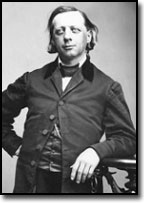
Henry Ward Beecher

Henry Ward Beecher

The following article was written by Henry Ward Beecher (1813-1887), one of the great American preachers in the nineteenth century.
I. THERE ARE THREE VIEWS OF THIS MATTER.

1. That this utterance is official and conclusive. Women are not to speak, however gifted they are.
2. That the authority of the apostle cannot settle the question. Paul forbad women to speak, but he had no business to.
3. That while the Scriptures are of binding authority in matters of faith and morals, this and other injunctions are local, national, and therefore transient.

This latter is the position now to be proved.

I. IT WAS NOT THE DESIGN OF CHRISTIANITY TO DETERMINE MANNERS, CUSTOMS, FORMS OF GOVERNMENT AND ECCLESIASTICAL INSTITUTIONS.

Its aim was to build a new man in Christ Jesus, and to this inspired manhood was left the utmost liberty in respect to externals. This view is corroborated by the whole testimony of history. The modern Church is totally different from the assemblies of the first Christians. The civil state has been revolutionised since the time of Christ. The family has changed, and no one organisation resembles the organisations of two thousand years ago. The presumption is that when Christ was leaving everything else to the wisdom and experience of after times it did not step in with this single exception and fix the position of women. Such a course would have been contrary to its genius in every other direction.

II. SUCH A UNIVERSAL, LIMITATION COULD NOT HAVE TAKEN PLACE WITHOUT VIOLENCE TO JEWISH IDEAS.

Woman was far more nearly equal to man among the Hebrews than among other Oriental nations. She was a public instructor. Note the cases of Miriam, Deborah, Hannah, Huldah, Anna, and the prediction of Joel, “Your sons and your daughters shall prophesy,” with Peter’s comment in Acts 2. So when the Spirit of God rests upon them, and they have a message to give, if you undertake to set up the letter of Paul round about them, I will set up the message which says, “On My handmaidens will I pour out My Spirit, and they shall prophesy.” True, in the synagogue it was forbidden women to teach, but the service was not extemporary, but liturgical and expository; and women had not the technical education for it. But outside the synagogue it was eminently in accordance with the Hebrew sentiment that women should speak out — and speak in meeting too.

III. ONLY TO GREEK CHURCHES WERE THERE SUCH LIMITATIONS TO WOMAN’S RIGHTS AND PRIVILEGES.

The text and 1 Tim 2:11,12were addressed not to Jewish, but to Greek assemblies. Why this distinction? Look at the condition of Greek women. The highest thought of womanhood that the Greeks had was that a woman should remain at home, that she should serve her husband and his household, and that she should not be known beyond her own family. She was not permitted to go into the street unless veiled, otherwise her reputation for virtue was destroyed. For a woman to do what is done by women in modern civilised nations — to develop that which the poorest man toils to give his daughters — to learn music, poetry, art, and philosophy, was to stamp her as a courtesan. Such being the popular feeling and custom, what would have been the effect if a Greek had looked in on a Christian meeting and seen a woman rise uncovered and pour out her heart? He would have said, “That is Christianity, is it? Why, then the Church is but a house of orgies. I understand your new religion. It teaches our wives that they must forsake their virtue, and go out into public exposure and do as courtesans do.” Therefore it was that Paul said, “You shall not violate the customs of your country. You shall not bring into discredit the religion of Christ by doing that which can be interpreted but in one direction by every man who sees it. I forbid your women to teach in Greek communities.”

IV. WHAT, THEN, MAY BE CONSIDERED A FAIR INTERPRETATION OF THIS?

1. Is it right to say that this is the last word which the genius of Christianity had for women? Are you to take a command which had a peculiar interpretation in one province of the globe and in no other, and make it the criterion for judging of woman’s position and instruction everywhere? Shall this be done where Christianity has raised and inspired woman, and shall a manacle, which belonged to the degradation of the Greek period, be put upon the limbs of enfranchised womanhood? You might as well say that the command of the physician to the leper is the prescription that you should take care of your children by.

2. Scripture commands are binding only where they apply: e.g., we are commanded to “honour the king,” but what about countries where there is no king? And you cannot give a rigid interpretation to the text without running against the whole fruit of civilisation for the last 1,800 years. Are you going to put back the shadow on the dial? Christianity has made woman a prophetess, and no false interpretation of the text can ever close her mouth.

3. It is fair to apply to this subject the argument of Peter in Acts 11:17. If in the providence of God women are called to preach, if their discourse is accompanied with power from on high, and blessed to the salvation of souls, then the Spirit itself bears witness to the right of woman to speak, and who are we that we should resist God?

4. Paul’s doctrine in Gal 3:27-28 is the Christian doctrine for the future. “In Christ there is neither male nor female.” Faith, hope, love, learning, eloquence, etc., have no sex. Whoever can bring the kingdom of God nearer to men has the right to do so. We have trumpets enough; let us have some flutes. Women can sing and speak in the secular sphere often to mightier effect than men; why not, then, in the Divine?

A Word to the Wise Rev. Marty Blackwelder

A Word to the Wise Rev. Marty Blackwelder

Marty Blackwelder is a graduate of Samford University and Rhema Bible Training Center.  He served on the staff of Kenneth Hagin Ministries for eleven years. Marty traveled as a member of  Kenneth E. Hagin’s Crusade Team from 1993 through May of 2004 assisting with the music ministry and teaching God’s Word.  He and his wife, Lola, also served as associate pastors of Rhema Bible Church in Broken Arrow, Oklahoma under Pastor Kenneth Hagin Jr.  In addition, Marty served as an instructor in Rhema Bible Training Center. Currently, Marty ministers in various Local Churches and Bible Schools around the world.  He and Lola are the parents of two daughters.  You can learn more about Marty’s ministry at www.blackwelderministries.org.


The Dilemma

First of all, I would like to qualify the content of the following paragraph by saying that my comments are not meant to be a criticism but are merely an observation. As I look around today in our modern Christianity, I am acutely aware of the fact that something is missing in our spiritual leadership and subsequently in the members of a new generation of believers that sit under our influence.

Richard Foster, a well-noted Christian author once said: “Superficiality is the curse of our age. The desperate need today is not for a greater number of intelligent people, or gifted people, but for deep people – those who will move beyond the surface into the depths.”

What the church needs today is not more educated theologians or more eloquent preachers and teachers, but true spiritual leaders who not only preach the gospel – but exemplify and reflect it’s reality in their own lives; those who live in and operate out of a divine flow of God’s presence and person and have genuinely made Him their continual dwelling place. Those who follow us must observe within us a true depth of spirituality. Not a shell of yesterdays experiences, not a fabrication of the anointing – but a fresh and recognizable reflection of one who has a current and intimate relationship with God – one whose ministry is an outflow and overflow of their own spiritual reality.

I suspect that by and large, there is a lack of personal and daily fellowship with God among those who are called to nurture that desire and hunger in others.  I have found in my own personal experience, that many times it is easier to busy myself with the work of the ministry, than to discipline myself in the spiritual necessities of the ministry. But I have also found that it is not always what is convenient, but what is necessary that I must consider. E.M. Bounds once said: “it is so easy to be seduced by the good to the neglect of the best, until both the good and the best perish.”

If you and I as ministers are to maintain the true substance from which all impacting and lasting ministry flows – then we must make a decision to keep first things first.

It is an unfortunate reality that we as ministers encourage our congregations or those to whom we minister to be faithful in their study of God’s Word, their times of prayer, and their fellowship with God – only to find ourselves neglecting these necessities due to the busyness of our schedules, the demands of home and church, and the endless preparation of sermons and lessons.

If we are not careful, we can find our relationship with God becoming one with the work of the ministry – only approaching God to prepare sermons and thereby losing our personal fellowship with Him on a daily basis. For many, the ministry becomes merely an empty form – simply going through the motions – void of the life and vitality with which it began. Certainly, this is not God’s intention for us.

For Your Consideration

The greatest example of a successful minister that we have is Jesus himself. In John 12:26, Jesus said “if any man serve me, let him follow me…” – this simply means, follow the example that I have set forth.

Jesus set forth an example of a man and a minister whose source of life, whose strength for ministry, whose joy for living sprang forth from a consistent and intimate fellowship with his Father.  In the midst of the constant companionship of his disciples and the daily demands of ministry, Jesus took time to commune with God in times alone.

Prayer in particular was a part of his daily routine. We can see from the following passages of scripture the importance that personal prayer had in Jesus’ life and ministry.

Matthew 14: 22-23 “And straightway Jesus constrained His disciples to get into a ship, and to go before him unto the other side, while he sent the multitudes away.  (23) And when he had sent the multitudes away, he went up in a mountain apart to pray: and when the evening was come, he was there alone.”

Mark 1:32-35 And at even, when the sun did set, they brought unto him all that were diseased, and them that were possessed with devils. (33) And all the city was gathered together at the door. (34) And he healed many that were sick of divers diseases, and cast out many devils; and suffered not the devils to speak, because they knew him.(35) And in the morning, rising up a great while before day, he went out, and departed into a solitary place, and there prayed.

Luke 6:12 “And it came to pass in those days, that he went out into a mountain to pray, and continued all night in prayer to God.

It’s obvious that Jesus placed high priority on his prayer life because he understood the value and the necessity of it. His time of devotion and prayer was both a place of refuge and comfort as well as a place of preparation and impartation. A demonstration of power has been and will always be a demonstration of fellowship.

The Impact of Prayer on Your Ministry

I have found the following quotes from men who have walked before us in life and ministry to be evident in their truth. I hope you will be inspired and motivated by them as I have been.

Charles Finney: “Truth by itself will never produce the full effect in a person’s life, without the Spirit of God – and the Spirit is given in answer to prayer. Sometimes it happens that those who are the most engaged in employing truth, are not the most engaged in prayer. This is always unhappy. For unless they have the spirit of prayer, the truth by itself, will do nothing but harden men in impenitence. Probably in the Day of Judgment, it will be found that nothing is ever done by the truth, used ever so zealously, unless there is a spirit of prayer somewhere in connection with the presentation of truth.

E.M. Bounds:  The preaching which is most successful is that ministry which has much of prayer in it.  How can a preacher preach effectively, make impressions on hearts and minds, and have fruits to his ministry, who does not get his message first-hand from God?  Not only is the preacher called to preach well, but he is also called to pray well.  Preaching which gives life is born of praying which gives life. Preaching and praying always go together, like Siamese twins, and can never be separated without bringing death to one or the other, or death to both.”

Charles Spurgeon: “Of course the preacher is above all others distinguished as a man of prayer.  He prays as an ordinary Christian, else he were a hypocrite.  He prays more than ordinary Christians else he were disqualified for the office he has undertaken.  If you as ministers are not very prayerful you are to be pitied.  If you become lax in this sacred devotion, not only will you need to be pitied, but your people also…”

Wow – these are quite direct and strong statements, but I’m not overwhelmed by them nor disheartened by their demand or implication – they don’t produce in me a mere sense of obligation or duty – for prayer is not merely a ministerial duty – but serves as a continual importer of God’s presence, person, and grace in my life and yours.

The Conclusion

So, what must we do to maintain our effectiveness, to have our ministry infused with the evident presence of the Holy Spirit and present not merely information to our listeners, but revelation and impartation of divine truth and the Spirit of God? What must we do to preserve our own spiritual lives, maintain both a depth and a true sense of joy along our journey?

The call of Christ to you and me as a sinner was COME!  Now his call to you and me as a believer and particularly as a minister is STAY! Stay close me – abide in me.

John 15:4-5 4 Abide in me, and I in you. As the branch cannot bear fruit of itself, except it abide in the vine; no more can ye, except ye abide in me.

5 I am the vine, ye are the branches: He that abideth in me, and I in him, the same brings forth much fruit: for without me ye can do nothing.

Personally, this is my hallmark scripture and one I strive to obey continually. My prayer for all of us is that we will run our race, keep the faith and finish our course with joy. Remember – when running our race – it’s not just the distance, but also the width. Let’s fulfill every dimension of the ministry God has for us – and let’s make a profound impact upon the lives of those we influence. Let’s create by example a true sense of hunger in a new generation to know God intimately and to desire his presence continually. Let’s do so by being men and women of prayer who have a passion for God’s word and presence.

Enjoy The Journey!

Marty

The Role of Women in the Ministry, Part 1 by Beth Jones

The Role of Women in the Ministry, Part 1
Beth Jones

Jeff and Beth JonesBeth Jones and her husband, Jeff, are the founders and senior pastors of Valley Family Church in Kalamazoo, Michigan, planted in 1991 and named by Outreach magazine as one of the fastest growing churches in America in 2009 and 2010. They also lead Jeff and Beth Jones Ministries, an organization dedicated to helping people get the basics. Beth and Jeff have four children and they make their home in the Kalamazoo area.

Beth grew up in Lansing, Michigan, was raised as a Catholic and at the end of her freshman year in college; she came into a personal relationship with Christ through the testimony of her roommate. It was there, at age 19, she realized God’s plan for her to preach and teach the gospel through writing and speaking. She has been following that call ever since.

Beth is the author of 20 books, including the popular 7 Basics book and the Getting a Grip on the Basics series, which has been translated into over a dozen foreign languages and is being used by thousands of churches around the world. She also writes The Basics Daily Devo, a free, daily edevotional for thousands of subscribers.

The heart of Beth’s message is a passion to help people get the basics! Through down-to-earth teaching, she helps people connect-the-dots and inspires them to follow Jesus and live the successful, fruitful lie God desires for them.

Beth attended Boston University in Boston, Massachusetts and received her ministry training through Campus Crusade for Christ and Rhema Bible Training Center in Tulsa, Oklahoma.

For more spiritual growth resources or to connect with Beth, please visit:
www.valleyfamilychurch.org
www.jeffandbethjones.org
www.facebook.com/jeffandbethjones
www.twitter.com/bethjones
www.instagram.com/bethjones

The following article is an excerpt from Pastor Beth’s book entitled, BREAKING THROUGH THE STAINED GLASS CEILING. To obtain your copy of this book, please visit www.jeffandbethjones.org.

Read Part 2 of this teaching.

Stained Glass Ceiling“I just want you to know; we’re leaving the church.” She said it as such a matter of fact. I was stunned and said, “Really? Why?”

At the time in 1992, my husband Jeff and I had been pioneering Kalamazoo Valley Family Church (now Valley Family Church) for about ten months when this young lady who had been faithfully serving as a lead teacher in our children’s ministry, told me she and her husband were leaving the church.

“It’s because of you,” she said.
“Me? What did I do?” I asked, as I prepared to hear what I had done to force them out.
“My husband doesn’t believe in women preachers,” and with that, she turned and walked away.

I was surprised and hurt. It was a sock in the stomach. Her remarks that day were the first of many such opinions I would hear over the years. Little did I know how controversial this topic could be!

The Bible Says Women Can’t…

I was raised as a Roman Catholic; our church leaders were priests and nuns—and the option of being a nun was never on my radar. When I became a born-again Christian, it was dramatic. Jesus radically changed my life! I loved Him. I loved following Him. I loved telling people about Him. When I felt God’s call to the ministry, I didn’t know what that would mean since I didn’t have much experience with the evangelical world or the “controversy” over women preachers or leaders.

I was in for a rude awakening.

I quickly learned some familiar phrases that I’d come to dread: “I don’t believe in women preachers; so, how can you teach the Bible?” “Why does your husband let you teach the congregation? Doesn’t the Bible say that women should be quiet in the church?” “You can teach the Bible, but only to other women—not to men—because you are supposed to be submissive and not have any authority over men.” “My friends won’t come to our church because we let women have leadership roles.” “This conference is for the pastors (men)—the wives are going shopping.”

A few comments stand out. Years ago, one man was trying to give me a compliment—I think. After I had spoken on a Sunday morning, he walked right up to me and said, “Personally, I don’t care for women preachers, but my wife watches you on TV and she loves you.” I was almost encouraged!

I remember a comment card I received about a month after we moved into one of our new church buildings. It was in the middle of our Grand Opening celebration and the card had these encouraging words, “Why does she speak? She doesn’t have anything to say!”

Many years ago, I received this email from a very genuine-hearted young man in our church:

I have been attending the church for a little while now. It is an amazing place to worship and I love it. But I recently invited my friend from work to come to the church with me. I told him the name and he said, ‘Oh.’ Then I asked him what was wrong with VFC. He replied with, ‘They have a woman pastor.’ I then questioned him. He told me to check out 1 Timothy 2:9-15, which talked about a woman’s conduct inside the church. Wow. I do not understand, if it says that women should not speak in the church, then why do they? I am not at all jumping on you, because I love how you are bringing lots of people to Christ. But I do not understand and I was kind of hoping you could explain it to me and help me to understand . . . I’m probably not the first one to ask you about this, but if you could take the time out of your busy schedule to answer this for me, I’d very much appreciate it. I still want to attend the church because of the beautiful and wonderful things that are going on there, but I don’t want to disobey God at all, in any way. If I can prevent myself from disobeying Him, I will. Thank you very much.

I’ve learned that when people question or make disparaging statements about women in ministry, these comments are generally not intended to be personally hurtful—even though they hurt deeply. They are often the result of personal convictions or religious upbringing and traditions learned by sincere people who love God and His Word.

By the way, that couple? They did leave the church and I embarked on an interesting journey with the Lord and His call on my life.

The Struggle

Like thousands of women over the past several centuries, I’ve had many talks and tears with the Lord about this very topic, because in my heart I just wanted to please Him. I didn’t want to disobey Him or His Word by thinking He had called me to lead and teach, when in reality He had not; nor did I want to disobey Him by not leading or teaching, when He had actually called me to do so.

To make matters more complicated, I felt strongly that the Lord wanted me to focus on leading and teaching in the church and writing books for the church. I’ve often felt conflicted about this and have asked God many times, “Why have You called me to lead and teach in the church—the very place that doesn’t believe in women like me?” I’ve even tried on numerous occasions to get the Lord to release me from being focused on the church.

Eventually, like other women before me, I embraced what I did not understand. Although it has not always made sense, God put a deep love and burden for the church—His Church—in my heart. I am convinced that serving the church is my sweet spot. It’s my lane to run in. I’m a pioneer, a shepherd and a Bible teacher at heart. (After all, my maiden name was Beth Shepard, and as a young girl, I sometimes wondered if it described my destiny! Beth means “house of God” and Shepard is a variation on “shepherd”—so, there ya go!)

The truth is, I love the church, the global Church and local churches. I love seeing what the Holy Spirit does in people’s lives through His Body, the church. I love everything the church is about: worship, evangelism, teaching, discipleship, relationships, transformation, growth, outreach, influence, creativity, healing, redemption and restoration, community, team, equipping and training! I love the way God uses His Church to bring the gospel to entire cities and regions.

I’m one of those people whose adrenaline gets pumping when we talk about church planting and church growth. Any time I see an empty building in any town around the world, my first instinct is to say, “That would be a great place for a church” and in an instant I envision a church taking up residence there. Whenever I have a creative idea for reaching people with the gospel, it is always connected to the church. When I write a book, my driving motivation is always, “How will this help the church help people?”

I get happy and fired up every time I read this passage about the power of His Church:

“All this energy issues from Christ: God raised him from death and set him on a throne in deep heaven, in charge of running the universe, everything from galaxies to governments, no name and no power exempt from his rule. And not just for the time being, but forever. He is in charge of it all, has the final word on everything. At the center of all this, Christ rules the church. The church, you see, is not peripheral to the world; the world is peripheral to the church. The church is Christ’s body, in which he speaks and acts, by which he fills everything with his presence.” (Ephesians 1:20-23, MSG, emphasis mine)

Over the past 30-plus years, I’ve studied the Scriptures and the various theological arguments on the subject of women in ministry, and teaching and leading in the church. I’ve spoken to other godly people about this subject. I’ve read books by Christian men I highly respected and I’ve listened to sermon messages on this topic. I’ve prayed. I’ve lived it. I’ve learned a few things. This book is about what I’ve come to understand from the Word and my own personal experience about the sometimes controversial role of women in the church.

Questions, misunderstandings and comments have led to confusion and hurt for many women who have sensed God’s hand on their lives and a strong call to serve Him with the leadership, executive, strategic, visionary and teaching gifts He’s given them. Some have given up and any dreams they’ve had have wilted and died a painful, quiet death under the stained glass. Others live in a perpetual state of disappointment knowing how much they could bring to the table in helping their husbands and their churches, if only they were given freedom to use their leadership gifts. Still others have revolted in their own version of “pastors’ wives gone wild” and have kissed the church goodbye.

I trust the lessons learned by me and the other women leaders profiled in this book will help those of you who feel called of God to teach, preach and lead in the church, but are restrained by the stained glass ceiling. I am also hopeful these pages will shed some light on this subject for the men who read this book.

Why This Book Now?

It’s time. Time for thousands of women (and perhaps men) to settle these questions: What roles should women have in the church? Does the overarching counsel of God’s Word teach that women must be silent in the church? Does the Bible teach that women cannot teach or preach in the church? Is it true that women are not supposed to teach men? Is it true that women are not to have any spiritual leadership role in the church?

This is a book about: Women. Leadership. Church. But, it’s not a book just for women. It’s a book for anyone interested in what could happen if thousands of women—called and gifted—were welcomed into leadership along with men in local churches around the globe to reach people for Christ and turn our church monuments in movements that will have a greater impact on this world.

This is a fresh biblical view of a topic that has been hotly contested for millennia. For those who are wondering what could help the church regain its relevance and influence in cities around the globe—this may be a huge missing piece and a secret weapon God wants to release in this hour.

This book is my story and the stories of a dozen other high capacity women called to leadership in churches around the world—and it’s giving a voice to thousands of other women who have prayed, worked, cried and carried on as they seek to serve the Lord and fulfill His calling on their lives.

I will be the first to admit that this book is not an exhaustive theological treatise on this subject. I do not address every verse of Scripture that relates to the role of women in ministry and church life and I may raise more questions than I answer. I also understand the fact that because I, as a woman, am writing this book, it could be perceived as biased from the start. I get that. As a “male counter-balance,” I have listed many excellent resources created by men on the subject of a woman’s role in the church at the end of the book, and I highly recommend them.

In the same way that a male gynecologist who’s delivered many babies can give authoritative, expert advice on having a baby, a woman who’s delivered six children has a different take on what it’s like to have a baby. They both speak with the authority of their perspective. He speaks with a medical authority, and she speaks with a different kind of authority. This book may fit into that category—a different look at this important Biblical subject. So, I hope you’ll join me to the very last page as we explore the role of women in the church.

How I Got Here

Let me start by sharing a bit of my story. I hope that through sharing my experience—we can get acquainted and those of you who are on a similar journey will be encouraged in knowing you are not alone.

It was 1979. I was minding my own business when God tapped me. The idea of being in the ministry or involved in a church at any level was not a thought I had ever considered as a teen or young adult. My life goals were simple: attend college, major in biology, become a dentist, get married, have five kids (who would all wear matching outfits on Easter) and play tennis.

As a freshman in college, I figured I would just have a good time, get my degree, go to dental school and live the life I envisioned. But God had a different idea. First, He used Andrea, my childhood friend and college roommate to lead me to Christ. When Jesus came into my life, everything changed—especially my life goals and priorities. My number one goal, as the oldest of four sisters being raised by a single mom, was to lead the rest of my family to the Lord. Within a short few years, this was accomplished and everyone in my family had given their lives to Jesus, yet the idea of leadership in the church was still non-existent.

The only experience I had being a “leader” in church after I was born again started and ended after one of the most embarrassing moments of my life. It was Sunday. My mom and stepdad were already at church and I was supposed to meet them, but running late. I wanted my new dress to look perfect, so it took me a little longer than usual to get ready, but I finally made it to church when the worship leader was starting the second song. Everyone was standing as I looked around the sanctuary to spot my parents—yep, there they were in the second row. I made my way to the pew and stood there along with everyone else praising the Lord and feeling pretty good about this new dress and myself.

When our pastor told us to “turn and greet and have a seat,” I made sure I greeted everyone to the north, south, east and west of me—after all, they needed to see how good I was looking! When I went to sit down, I smoothed my dress under my behind, only to discover something was missing—primarily, my dress! Unknowingly, in my hurry, I had tucked my dress and my slip into my panty hose. I sat down and tried to figure out a way to untuck. Then I began to go through the list, Who’s behind me? Who saw me walk down the aisle? How long was I standing there with my hands in the air and my ‘tush’ exposed? I was mortified and humiliated! I have no idea what our pastor preached on that day. That experience sealed it—the idea of being a “leader” in church was not something I desired…at all!

That changed one afternoon in 1979. I was a sophomore in college at Western Michigan University and while sitting in my dorm room and meeting with Debbie, the Campus Crusade for Christ Group Leader who was mentoring me, God interrupted my plans! She shared a little book with me titled: Have You Discovered God’s Plan for Your Life? I had not discovered God’s plan. I didn’t even know God had a plan. I figured God would bless my plan, and my plan was to become a dentist! As she was reading that booklet to me, she came to Romans 10:13-15 and it jumped off the page;

“’Everyone who calls on the name of the Lord will be saved.’ How, then, can they call on the one they have not believed in? And how can they believe in the one of whom they have not heard? And how can they hear without someone preaching to them? And how can anyone preach unless they are sent? As it is written: ‘How beautiful are the feet of those who bring good news!’” (NIV)

Time stood still for a few moments and I suddenly knew God was calling me. This was a monumental moment. I knew I couldn’t be a dentist. If God was just looking for preachers—people who would tell others how to not spend an eternity apart from Him—how could I be a dentist and let people go to hell?

The way I saw it, if all people needed to do in order to be saved was to call on the name of the Lord, and if the only reason they hadn’t called on the name of the Lord was because they had not heard, then, I had to tell them. It seemed as if God spoke to my heart with a huge announcement: “I interrupt your life to bring you this very important message. You are not going to be a dentist. You are going to tell people about Me.” From that moment on, my life and purpose changed!

Although I had no idea what being called to the ministry would actually look like, somehow I knew that the primary way I would be telling people about Jesus would be through writing and teaching, and that one day when I got married, I would be working together with my husband to build a church and raise a family.

My Story Is Probably a Lot Like Your Story

As it turned out, this has indeed been God’s plan for my life. I left Western Michigan University, transferred to Boston University and changed my major to learn all I could about Communications and Public Relations—for the purpose of preaching the gospel. After I graduated from college, I spent several years serving the Lord through various campus ministries, churches and non-profit organizations. Then I received my ministry training from Rhema Bible Training College.

In the process of time, I met my husband Jeff and after we were married, we did start a family—and a church—and I’ve been teaching and writing books. We had four children—well, actually five if you count the church!

When it comes to our family—Jeff and I love the privilege of being parents and I can say without hesitation, our kids have been our most important ministry and our greatest joy! Meghan, our oldest daughter, was three years old, Annie was ten months old, and I was pregnant with our third child, Luke, when we pioneered Valley Family Church in 1991 in Kalamazoo, Michigan. Three years later in 1994, we had our youngest son, Eric. Pioneering a church while raising four preschoolers meant that I was pregnant for about six years in a row, and Jeff and I lived with one nostril above water. Sleep was worth more than money. We leaned on God’s “grace for the pace” daily and loved every second of it! (Well, maybe not every second.)

We were a little nervous about raising “pastor’s kids!” Neither Jeff nor I were raised in a pastor’s home, so we were clueless how to do this. You’ve probably heard stories about pastor’s families and “pks,” pastor’s kids. We did too! Horror stories! That’s what freaked us out! Since we didn’t know what the “proper protocol” was, we just did our best to work at having a fun family, enjoying our marriage and raising kids who loved God and others. We had two major rules in our home: You can’t call anyone ‘stupid’ and whatever you do, first ask, ‘Would this please the Lord?’ We weren’t perfect and our kids weren’t perfect but our approach seemed to work, and now that our kids are young adults, the verdict is in—our kids turned out to be really nice people. They love God and they all feel called to the ministry and are actively serving as leaders in our church. We have no complaints! Our family is one of the most rewarding things God has blessed us with. Then, there is that fifth child…

It turns out that Valley Family Church was our fifth child—we didn’t realize it at the time—but in truth, she was! She was a growing child—demanding and strong-willed—we loved her with all our heart and she brought great joy into our lives! We gave birth to VFC with five adults and four kids and since that time, our church has grown to include thousands of people who call us home—along with a couple of campus launches and a church plant.

From the beginning, we felt it was our job to build a multi-generational church that would help people “get it.” In simple terms, our church exists: to help people get it, and that means…

The lost get saved.
The saved get victory.
The victorious get trained.
The trained get going.

Our goal was to build a church that would successfully blend reaching lost, unchurched people; while at the same time, equipping believers to live the Spirit-filled life of faith so they could reach out to more lost and unchurched people. This is no easy task. For some, our church isn’t deep enough, for others we are too deep. Perhaps this is a compliment?

The best and only way we know to measure our effectiveness is: fruit! Forty-percent of those who attend our church tell us they were not attending church anywhere prior to coming to our church—that makes us very happy! Those who did know the Lord before attending our church tell us they are growing at an exponential rate as God’s Word comes alive in their hearts. The fruit we’ve seen in people coming to know Jesus Christ and the spiritual growth we’ve seen in their lives of others has truly been “our joy and our crown!”

In order to raise our own four children (Meghan, Annie, Luke, Eric) and our fifth child—Valley Family Church, we felt God called us to work together as a husband-wife team. In our roles at home, we are “mom and dad” and we share all that goes with raising a busy family. In our roles as the senior pastors, we are the “spiritual mom and dad” of the House and we share all that goes with raising a busy church family. We have our unique gifts, responsibilities and roles and yet, we work on many things together, including: teaching, strategy and execution. We cast vision, lead the staff and oversee the church as a husband and wife team and since 2003, we have split the weekend preaching 50/50. God has blessed our approach in leading our family and church as we have endeavored to live by Psalm 34:3, “Oh, magnify the LORD with me, and let us exalt his name together.”

Thankfully, we’ve had help! The Lord has surrounded us with a great staff and team of volunteers. Early on, He called several special people to help us at home with our kids—and we are forever indebted to them. The Lord has called hundreds of other people to use their gifts to come alongside and help us build a church. Like most pastors, we feel that we have the best staff, lay leaders, volunteers and church family in the world! As a church, we have lived on God’s fulfillment to His promise to command His blessing on our church as we all walk in unity, “Behold, how good and how pleasant it is for brethren to dwell together in unity… For there the LORD commanded the blessing—life forevermore” (Psalm 133:1, 3).

In addition to my role in working together with my husband to pioneer and grow the church, as I mentioned, a large part of my calling has been to write books to help people get the basics. God has enabled me to write around twenty books, including, the 7 Basics and the Getting a Grip on the Basics series, which are being used by hundreds of churches in America and have been translated into over a dozen foreign languages around the world.

So, that’s part of my story. I’ll share more later.

Gutter Balls

As you can see, although serving God in ministry was not on my original radar, I eventually figured out how to accept, embrace and step into God’s calling to be a leader in our church. But to be honest, it was a process—and I had to learn how to quit throwing “gutter balls.”

In the early years of planting our church, I was idealistic, optimistic and certain that everyone would want to help us win all of Southwest Michigan to Jesus. But after a few years of pioneering, I got weary of being rejected by those who did not approve of my role. Their negative comments wore me down to the point that for a few years, I let insecurity, intimidation, and the “fear of man” dominate me and I threw “gutter balls.” That is, I backed off from following my heart, passion and purpose. I shrank back from doing much of anything public that looked like leadership, being on the platform or teaching God’s Word. I threw gutter balls so I would not appear to be a leader.

Let me explain a gutter ball. When I was in junior high school, a group of us boys and girls went bowling one day. My mother taught my sisters and me a simple rule of thumb: “. . . in sports, don’t beat the boys.” (It was a different era then. I don’t know too many teenage girls that would embrace that philosophy these days!)

Normally I wasn’t a very good bowler, but that day I must have been in the zone because I found myself bowling strikes and spares. However, I knew if I continued to bowl well, I’d beat the boys and that was a “no-no.” So, what did I do? I started throwing gutter balls—on purpose! I marched up to the line, acted like I was trying to get a strike, and then at the last minute I’d throw my bowling ball toward one of the gutters to make sure I didn’t win.

Sadly, that mentality resurfaced as I navigated my role as a woman in church leadership. I had “reluctant leader syndrome.” At times, it was just easier to throw a “ministry gutter ball” and not step up to the plate, or God’s calling, in order to avoid being criticized. Fortunately, my husband wouldn’t let me throw gutter balls for too long. He has always been my biggest encourager, and his consistent support has been immeasurable.

In addition to my husband’s words of wisdom, my greatest comfort has been in sensing God’s encouragement and approval. One day, as I drove around Kalamazoo praying for our city, I was feeling particularly “gutter-ball-minded” and the Lord quickened this verse to me, “Do not be afraid, but speak, and do not keep silent; for I am with you, and no one will attack you to hurt you; for I have many people in this city” (Acts 18:9-10, NKJV).

As I embraced this word, my heart was anchored. God has confirmed His calling time and time again. Every now and then I’ll hear Him speaking, almost singing this Glen Miller song to my heart, “I’ve got a gal in Kalamazoo . . .” Knowing that I am “His gal” makes all the difference, and is a great source of encouragement in my calling.

Stained Glass or a Concrete and Rebar Ceiling?

You’ve heard my story, but what about yours?

I know you are out there because I have talked to hundreds of you. It’s possible that in your organization or church world, the “stained glass ceiling” isn’t made of stained glass, but of concrete and rebar. The idea of leading or teaching the Word to others is in a galaxy far, far away. Maybe you don’t feel called to pastoral ministry, teaching or preaching, but you do feel that your leadership gifts and passion for the cause of Christ could serve the church in other ways—through creative arts, worship, media, communications, executive operations, connections, spiritual development, finance, kids and student ministries, outreach, technological, legal or justice initiatives or a host of other areas—if only you were given the chance.

In a galaxy far, far away . . .

I understand. We’ve seen it . . . and you’ve seen it. Women—who are tremendous wives and mothers, as well as spiritually mature and anointed with wisdom, faith, leadership, executive, administrative, organizational, creative, entrepreneurial and/or teaching gifts, and have paid their “faithfulness” dues—seem to be stuck in an orbit which only includes creating the bulletin, singing in the choir, playing the piano, hosting showers, doing secretarial work or making chicken divan casseroles for funerals.

An added dilemma for high-potential, high-capacity women called to the ministry is to watch ill-equipped, immature, incompetent, and inexperienced men move up the leadership ladder in church, passing by exceptionally qualified, godly women—simply or only because they are men.

The result of this standard operating procedure in the church is that many gifted, called, and anointed women have given-up and are using their gifts outside the church. They’ve been accepted as lawyers, brain surgeons, dentists, accountants, editors, broadcast journalists, engineers, architects, entertainers, film-makers, designers, entrepreneurs, university presidents, CEOs, governors, senators, prime ministers and presidents; but they have been banned from leadership in many churches. What a loss for the global Body of Christ and local churches everywhere.

Is that really God’s plan?

Hang In There

Girls, what about you? Is the cause of Christ what you are most passionate about? Is God’s Word burning in your heart like a fire shut up in your bones? Has God wired you to be a pioneer, innovator, church planter, campus pastor, teacher, preacher or leader in the church?

Are you discouraged because no one has validated your call as authentic and God-given? Do you feel pregnant with a vision and about to burst? Are you a woman who’s felt God’s call to the ministry—but you’ve experienced so much disapproval, rejection or criticism, you’ve given up? Have you been given limited opportunities to do what’s in your heart, but it’s usually the role no one else wants and there’s no budget to support it? Have you prayed for God to just “take away” your desire to proclaim His Word? Have you asked the Lord if He gave you the wrong gifts? Have you faced the frustration of closed-door-after-closed-door in your local church? Have you felt despised, overlooked or misunderstood? Have you been tolerated, but not accepted? Have you been dismayed by the critics? Have you been throwing “gutter balls” or living in a state of perpetual “reluctant leader” syndrome? Perhaps you can relate to one or all of these questions. If you’ve had high hopes and extreme patience, I know that the deferral of your hope can make your heart sick. Hang in there! Don’t give up! God hasn’t forgotten about you.

Don’t quit. Don’t give up!

Let me encourage you. Shifts are happening in both the global and local church. I don’t know how or when, but you can trust the Lord. He has your back. The Bible says, “And I thank Christ Jesus our Lord who has enabled me, because He counted me faithful, putting me into the ministry” (1 Timothy 1:12, NKJV). Don’t be discouraged! If God is for you, who can be against you? Stay faithful! Do what you know to do. He will produce eternal fruit through your life and eventually others will recognize His hand upon you. The most important thing isn’t the approval of man, but the approval that comes from God.

It’s my prayer as we tackle this topic, breaking through the stained glass ceiling, that you sense the Lord encouraging you, strengthening you, and filling you with renewed hope in your calling.

The LORD will guide you continually, and satisfy your soul in drought, and strengthen your bones; you shall be like a watered garden, and like a spring of water, whose waters do not fail (Isaiah 58:11, NKJV).

Read Part 2 of this teaching.

This article is an excerpt from Pastor Beth’s book entitled, BREAKING THROUGH THE STAINED GLASS CEILING. To obtain your copy of this book, please visit www.jeffandbethjones.org.


Wired for Relationships By Pastor Jim Herring

Wired for Relationships
By Pastor Jim Herring

Pastor Jim HerringRev. Jim Herring is gifted Bible teacher who ministers God’s Word in a passionate, powerful, and practical way. The focus of Jim’s ministry is to help believer’s overcome the trials of life, walk by faith, and reach their full potential in life.

Jim graduated from Rhema Bible Training Center in Tulsa, Oklahoma specializing in Pastoral ministry. He also holds a Bachelor’s Degree in Church Ministry from Southwestern Assemblies of God University in Texas.

Jim and his lovely wife, Samantha, are the founders and senior Pastors of Abundant Life Family Church in Fort Worth, Texas. They lead a vibrant, thriving, and multi-cultural church in the heart of Texas. Jim and Samantha are also the proud parents of two children, Annabel and Andrew.

RelationshipsThere was a movie several years ago called, “The Good, the Bad, and the Ugly.” I don’t remember what the movie was about but it does accurately describe our relationships.
Every one of us maintain multiple relationships. Some of them are great, some are good, some are bad, and a few may be downright ugly! Regardless of the state of our relationships, understanding and applying God’s Word to our life and relationships will help us find a higher degree of personal peace and fulfillment.

You Were Created to Be Relational

In the very beginning of the Bible we learn an important truth – God created you with a need for human relationships. In Genesis chapters one and two we find the account of creation. God created the land, the sea, the birds, the fish, the animals, and then He created man. God looked over His creation and declared it to be very good (Gen. 1:31).

When God breathed life into man, he came alive and enjoyed a relationship and fellowship with God. The Bible infers that God would come and talk with Adam in the cool of the day (Gen. 3:8).

Shortly after the creation of man a crisis arose. What was that crisis? Some say it was the temptation and ultimate sin of Adam and Eve. Others say it was when Cain killed his brother Abel. However, both of those responses are incorrect. God Himself identifies the first crisis in the Bible. The first crisis was a relational crisis.

Notice what God said.

Genesis 2:18
18 And the Lord God said, “It is not good that man should be alone; I will make him a helper comparable to him.”

The first problem that God addresses is aloneness. The reason this is a problem is because God created man with a need for relationship. In other words, we are deficient by design. Yes, we are fearfully and wonderfully made but we are also needy. We need healthy relationships with other people!

When God said, “It is not good for man to be alone”, He was not referring to divine relationship. Adam already enjoyed a relationship with God before God made the “alone” statement. Early in human history God was teaching us a valuable lesson – we need relationships with other people.

Over the years I have heard people make the statement, “All I need is God.” While that sounds religious and holy it is actually unscriptural. God created man with a need for divine relationship and human relationship. When either is missing, problems arise.

Marriage Is Not the Only Solution for Aloneness

Look again at what God said in Genesis.

Genesis 2:18
18 And the Lord God said, “It is not good that man should be alone; I will make him a helper comparable to him.”

Pay special attention to what God did and did not say.

  1. God did not say, “It is not good for man to be unmarried.”
  2. God did say, “It is not good for man to be alone.”

The problem of aloneness can be solved by being around other people – not just marriage. In fact, there are some married people who are alone. They don’t speak to each other. They sleep in separate beds. They pursue their individual dreams, goals, and hobbies. In essence, they have a marriage contract not a marriage covenant. They have a business agreement, not a healthy, loving relationship.

Created for Community

In his article, “The Snare of Isolation”, Jimmy Miller writes, “You were created for community, fashioned for fellowship, and formed for family.” The New Testament emphasizes the value of relationships and community repeatedly – over and over again we find “one another” scriptures.

  1. John 15:2 tells us to “love one another.”
  2. Ephesians 4:32 tells us to “be kind to one another.”
  3. Colossians 3:13 tells us to “forgive one another.”

God created us with a need for “one another” and responsibilities toward “one another.” He created us with a need for loving relationships with others.

Even secular surveys reveal our desire for relationship. Researchers interviewed people in an effort to determine what makes them happy. Surprisingly, the number one thing was not success, wealth, achievement, or even good looks. The number one contributor toward personal happiness was close meaningful relationships with other people!

Relationally Challenged

In our society it is easy to become relationally challenged. Think about it.

  1. You can do your banking through a machine with no human contact.
  2. When you call a business you are most often greeted by voicemail.
  3. You can email business and personal contacts without ever seeing real people.
  4. You can drive in your garage or apartment without ever talking to anyone.
  5. You can order your clothes, food, books, CDs, gardening equipment, and even household appliances, all online without talking to one single person.

Drs. Les and Leslie Parrott noted the following: “Neglecting your longing for relationship by claiming to be above it is as foolish as pretending you can live without food.”

Initially, that may sound a little far-fetched. Are relationships really that important? Can relationships really affect my health? Absolutely!

There were two independent studies done that illustrate our need for relationship. One was done by the University of California at Berkeley and the other was done by the University of Michigan. Both studies found that adults who do not cultivate nurturing relationships have premature death rates twice as high as those with frequent caring contact. James S. House of the University of Michigan said, “The data indicates that social isolation is as significant to mortality as smoking, high blood pressure, high cholesterol, obesity, and lack of physical exercise.”

The bottom line is this – you were wired for relationship! In order to help you navigate the relational waters in your life, I want to give you three fundamental truths about relationships.

1. Successful relationships require continual work.

If you are going to develop successful relationships it will require your time and energy. It will also require listening and communicating. In addition, personal sacrifice and investment are also part of the continual work needed to nurture healthy, loving relationships.

2. Always remember, the fruit of successful relationships always outweighs the cost.

The joy and fulfillment you will experience from developing healthy relationships is worth the effort. Peace, love, trust, and intimacy in a marriage are the wonderful byproducts of work and effort.

3. The starting point for developing healthy relationships begins with you.

Author Myles Munroe once wrote, “An omelet is only as good as the eggs you use.” When you mix two people together, their spiritual growth is the biggest key to having a good “omelet.” What can you do to improve your relationships – improve yourself. Nurture and develop the fruit of the spirit in your life (Gal. 5:22-23). Endeavor to grow in love, peace, joy, longsuffering, goodness, kindness, and self-control. Remember this – a better “we” always begins with a better “me”!

The Role of Women in the Ministry Part 2 by Beth Jones

The Role of Women in the Ministry, Part 2
Beth Jones

Jeff and Beth JonesBeth Jones and her husband, Jeff, are the founders and senior pastors of Valley Family Church in Kalamazoo, Michigan, planted in 1991 and named by Outreach magazine as one of the fastest growing churches in America in 2009 and 2010. They also lead Jeff and Beth Jones Ministries, an organization dedicated to helping people get the basics. Beth and Jeff have four children and they make their home in the Kalamazoo area.

Beth grew up in Lansing, Michigan, was raised as a Catholic and at the end of her freshman year in college; she came into a personal relationship with Christ through the testimony of her roommate. It was there, at age 19, she realized God’s plan for her to preach and teach the gospel through writing and speaking. She has been following that call ever since.

Beth is the author of 20 books, including the popular 7 Basics book and the Getting a Grip on the Basics series, which has been translated into over a dozen foreign languages and is being used by thousands of churches around the world. She also writes The Basics Daily Devo, a free, daily edevotional for thousands of subscribers.

The heart of Beth’s message is a passion to help people get the basics! Through down-to-earth teaching, she helps people connect-the-dots and inspires them to follow Jesus and live the successful, fruitful lie God desires for them.

Beth attended Boston University in Boston, Massachusetts and received her ministry training through Campus Crusade for Christ and Rhema Bible Training Center in Tulsa, Oklahoma.

For more spiritual growth resources or to connect with Beth, please visit:
www.valleyfamilychurch.org
www.jeffandbethjones.org
www.facebook.com/jeffandbethjones
www.twitter.com/bethjones
www.instagram.com/bethjones

The following article is an excerpt from Pastor Beth’s book entitled, BREAKING THROUGH THE STAINED GLASS CEILING. To obtain your copy of this book, please visit www.jeffandbethjones.org.

Read Part 1 of this teaching.

Stained Glass CeilingIf you want to start a fight in church, initiate a conversation about women preachers and within 45 minutes, you can split that church four ways! As every woman in a high profile role in the church knows, there are many different views on this subject. Those views often carry strong emotions.

Years ago, I led a man to the Lord and as I spoke with him on numerous occasions, he told me in no uncertain terms that he didn’t believe in women preachers, further, he was not interested in attending our church, reading any of the books I had written or hearing me teach or preach the Word. One day, he went so far as to tell me I was not even saved. As it turns out, this man was my dad. Of course, his words cut deeply and I had to seek God’s help to tune them out and look to my Heavenly Father and His Words to carry on in His calling. (Today, my dad is in heaven and I have the hope that he sees things differently now.)

My guess is that if you are a woman in leadership or in a teaching or preaching role in the church, you’ve had similar experiences. And, if you’re like me, while there are a few naysayers, God finds a way to trump them all with His still small voice and by prompting people to speak kind and encouraging words just when you need it. (In fact, I hope you hear the Lord’s still small voice and sense His love and affirmation for you personally as you read these pages!)

In writing this book, it is not my goal to defend, argue or convince anyone of anything. My primary goal in writing is to inspire, empower, encourage and cheer for you young girls and older women who have felt alone, rejected and misunderstood as you seek to follow God’s call on your lives. My goal for all other readers is that they simply consider looking at this topic with a fresh set of eyes.

This book is written for…

Women of All Ages: It’s written to encourage and motivate women of all ages who feel called of God to change the world—to break through the stained glass ceiling—to pioneer churches, teach the Word, write books, start ministries, lead worship or serve as leaders in churches.

Men of All Distinctions: It’s written to enlighten men who have a wife with an insatiable hunger for serving God and teaching the Word. It’s written to help the father whose daughter has a heart for the Lord and potential leadership or speaking gifts. It’s written for brothers with sisters and boyfriends with girlfriends who feel called to the ministry.

Church Leaders of All Breeds: It’s written to encourage pastors or church leaders who are unsure of, or are rethinking, the role of women in their own churches.

Many people are giving this topic considerable thought these days and thankfully, more and more Christian leaders see the value of women in the church. In this chapter, let’s lay some groundwork and then we’ll dive into the Scriptures.

Big Ministries

As we begin, it’s worth mentioning that some of the largest, most influential and effective ministries and churches around the world have placed a high value on women and their role in the church.

Despite some recent setbacks, the largest church in the world, Yoido Full Gospel Central, located in Seoul, Korea with a 2014 membership of 1,000,000 members, (1) has been built largely by women in leadership through cell groups according to Pastor David Yonggi Cho (formerly known as Paul Yonggi Cho).

He began to see that by doing everything himself he was robbing his people of the chance to grow. From this he learned the importance of delegation and of training up the people for the work of the ministry. Cho then went on to devise his plan to minister to the people through a network of home cells and using the people to lead them. He took this plan to the deacons, but they said no. He then took the idea to the deaconesses and they accepted it. They realized that the biggest problem with this was going to be for the men to come under the authority of women leaders. Women in Korea had always taken a subordinate role and as Cho says, ‘There is no feminist movement in Korea.’ They overcame this problem by having the women wear caps to signify that they were under Cho’s authority. Using the women as leaders they started with 20 home cells. This quickly grew to 150 groups. (2)

Joyce Meyer, one of the most widely read, listened to, and well-known female Bible teachers in the world today, is being used by God to reach millions of people through TV, radio, and books.

Joyce Meyer is one of the world’s leading practical Bible teachers and a New York Times bestselling author, spreading God’s Word to millions of people each year. Suffering sexual abuse as a child, Joyce discovered the freedom to live victoriously by applying God’s Word to her life and, in turn, seeks to help others do the same. She has written over 70 books, conducts close to fifteen conferences annually, and reaches a potential audience of 3 billion people worldwide with her Enjoying Everyday Life® broadcast. Time magazine selected Joyce as one of the most influential evangelical leaders in America. (3)

Australian Darlene Zschech’s biography reads like a woman who is being mightily used of the Lord through serving in leadership, pastoral ministry and preaching via song.

Darlene Zschech is acclaimed all over the world as a singer, songwriter, worship leader and speaker, most notably for spearheading the music that comes from Hillsong Church. Although she has achieved numerous gold albums and her songs are sung in many nations of the world, her success simply stands as a testimony to her life’s passion to serve God and people with all her heart. Darlene, alongside her husband Mark, are Senior Pastors of Hope Unlimited Church on the Central Coast of New South Wales, Australia.

As a songwriter, Darlene is perhaps most famous for the chorus “Shout to the Lord,” a song that is sung by millions of churchgoers every week and has been covered by many other artists. “Shout to the Lord” was nominated as Album of the Year for the 1997 Dove Awards and was nominated as Song of the Year for the 1998 Dove Awards. In 2000, Darlene received a Dove Award nomination for Songwriter of the Year and received the International Award for influence in praise and worship.

Darlene is also passionate about raising and training other worship pastor, leaders, teams and writers and has written four books – “Extravagant Worship,” “The Kiss of Heaven,”  “The Art of Mentoring” and the new “Revealing Jesus” devotional. These titles combined have been translated into over 20 different languages. (4)

Henrietta Mears, simply known as “Teacher” to countless men and women, was the Director of Christian Education and the teacher of the College Department at the First Presbyterian Church of Hollywood from 1928-1963. She also founded Gospel Light Publications and Gospel Literature International, which have been used around the world to bring gospel publications to thousands of churches. Such notables as Dr. Billy Graham, Senator Mark Hatfield, Dr. Charles Fuller, Dale Rogers, and the late Dawson Trotman (founder of The Navigators) and the late Dr. Bill Bright (founder of Campus Crusade for Christ) were impacted by her influence as a Bible teacher, church leader and godly woman in an era where women had very few rights. (5)

Dr. Bill Bright had this to say about her influence in his life, “I have had the privilege of knowing many godly pastors and great Christian leaders, but no one has influenced my life more than Dr. Mears.” (6) Dr. Richard Halverson, Chaplain to the United States Senate said this, “In my mind, Henrietta Mears was the giant of Christian education-not only in her generation, but in this century. She was an extraordinary combination of intellect, devotion, and spirituality; an administrative genius, a motivator, an encourager and a leader. I thought of Henrietta Mears as a female Apostle Paul; in fact, I often referred to her as the ‘Epistle Paul.’ There is simply no way to exaggerate her effectiveness as a teacher, communicator and inspirer.”(7)

In modern times, I have had the distinct pleasure of meeting Jo Anne Lyon, the first woman to serve in the top leadership role of the Wesleyan denomination as the General Superintendent. She serves to guide the vision, key message, and missional priorities of the Wesleyan Church, which is transforming lives, churches, and communities with the hope and holiness of Jesus Christ.

She speaks with grace and wisdom and carries a strong, strategic, leadership anointing. She is passionate about what God is doing in calling women to the ministry in unprecedented numbers these days, both those in college and seminaries as well as second-career women. In her recent article, “Men and Women – An Article on Spirit-Filled Believers” she said this,

In the tour of a church in Ft. Worth, Texas, that has set the pace for planting churches and reaching the world in the most difficult places my eyes fell on a painting hanging in the hallway. I was captured by what appeared to be the backs of a crowd of people shrouded in grey. However, there was one person in red. The pastor explained: this represents a woman who pastors a church of 100,000 – yes, I did not add a zero – in North Vietnam. The artist depicted her among the crowds of people who do not know Jesus as the one who is “covered by the blood.”

I stood before that painting with eyes filled with tears. The courage of this woman to proclaim the gospel in a place of persecution! The faith of this woman to know Jesus and the power of the resurrection! The obvious attraction and hope of Jesus through her!

I then reflected on the thousands of women who are church planters in China, many between the ages of 18-24 with some 30 million followers. Again, the courage, faith and power of the Holy Spirit make this possible.

I was again drawn to the words of Joel which were preached by Peter at Pentecost:

“In the last days, God says, I will pour out my Spirit on all people. Your sons and daughters will prophesy, your young men will see visions, your old men will dream dreams. Even on my servants, both men and women, I will pour out my Spirit in those days, and they will prophesy” (Acts 2:17-18 NIV).

God is calling women to the ministry in unprecedented numbers these days, both those in college and seminaries as well as second-career women. Whether they are in North Vietnam and China, or Virginia and Canada, I believe a new Pentecost is rising with them. (8)

I also want to mention Bill Hybels, the founder and pastor of the influential Willow Creek Church. I have never had the pleasure of personally meeting Bill Hybels (although he is from Kalamazoo and graduated from the high school our children attended), but he has been a champion for women in ministry since the earliest days of Willow Creek’s existence. On Twitter, he posted links to two very moving, must-read articles; one written by he and his wife, Lynne, and the other written by their daughter, Shauna. I must admit that I had a hard time reading these articles because of the lump in my throat and the tears in my eyes. They put into such eloquent words the things I and many other women have experienced in their callings to serve God in ministry and in leadership in the church. If you are a woman who feels called to the ministry and to leadership in the church, I implore you to read both of these articles. Here’s an excerpt from Bill and Lynne Hybels’ article, “Evangelicals and Gender Equality,” regarding the time they had to define their position on women in church leadership.

…the increasing visibility of Willow in secular and Christian media forced us to define and articulate our position. Questions began pouring in about why we “allowed” women in leadership. Did we have a rational defense for our position? In response, we commissioned our elders to do an intensive, eighteen-month scriptural study of the issue of women in leadership. I did not feel it was right to sideline the women whom God seemed to be using while we did this study, so we pursued a parallel track of study and continued observation of how God worked among us through the leadership efforts of both men and women.

Dr. Gilbert Bilezikian, a Wheaton College professor and Willow Creek elder, led the study. The conclusions of the study were published in 1985 in Bilezikian’s book, Beyond Sex Roles: What the Bible Says about a Woman’s Place in Church and Family. In summary, we concluded that before the Fall, men and women related to each other as co-regents, both bearing the image of God and called to join together in caring for the world he had created. Both men and women were responsible to fulfill their ministries of service for God’s glory in the manner God had gifted them and to the degree to which they had been apportioned faith. Tragically, in the Fall, this cooperative relationship between men and women was deeply wounded. We believe God’s gracious plan for redemption is that everything that was broken through sin—including the relationship between men and women—might be restored to the beauty that existed during the first days of Creation.

Many devout, intelligent Christians disagree with our conclusions. There will come a day when we will all find out the degree to which we have veered from God’s perfect wisdom, in this issue and many others. Until then, I hold this position humbly, yet firmly. I am willing to take the risk of encouraging women to do what I believe scriptures ask of them—to make themselves fully available to the full range of spiritual gifts. (9)

There is no doubt that God has richly blessed Pastor Cho, Joyce Meyer, Darlene Zschech, Henrietta Mears, Jo Anne Lyon, Bill and Lynne Hybels and their ministries—and a growing list of other ministries and churches where women have been given a high profile in leading, teaching and preaching.

Leaving a Legacy

Perhaps you can think of other legacy-leaving women preachers, teachers and leaders. Aimee Semple Mcpherson was a woman ahead of her time, as an evangelist and founder of the Foursquare Denomination in the early 1900’s. (10) Maria B. Woodworth-Etter was an evangelist well-known in the Assemblies of God circles for her dynamic preaching and life of faith. (11) Kathryn Kuhlman was greatly used of God. She was known for her dramatic preaching and healing ministry which began in the late 1940’s and later for her radio and television ministry. When asked, “What do you regard as the ultimate goal of your ministry?” She replied: “My purpose is the salvation of souls. Divine healing is secondary to the transformation of a life.” (12)

In modern times, Bishop T.D. Jakes has been championing the role of women through his conferences and bestselling book, “Woman Thou Art Loosed.” (13) Pastor Bobbie Houston, married to Pastor Brian Houston from Hillsong Church in Australia, has been leading and empowering an army of tens of thousands of women through her annual Colour Conferences. (14)

Nancy Beach is a pioneer among women leaders in the church and serves as the executive vice president of programming and production for the Willow Creek Association, a teaching pastor at Willow Creek Community Church and is the author of Gifted to Lead: The Art of Leading as a Woman in the Church. Nancy has been blazing a trail for many years. She is still hopeful regarding the role of women in the church and she had this to say about her role as a woman in leadership in her honest article titled, “Women in Leadership—Disappointed, but Not Despairing.” (15)

Almost 30 years ago when I started serving on staff as a church leader, my role on the Management Team was somewhat pioneering, at least for our church. As the first female on that team, and later, the first female Teaching Pastor, I sought to do the work of ministry as best I could, hoping that my gender would actually not be a big deal or a barrier. I am deeply grateful for the opportunities I had, for the adventure of learning in the trenches of leadership, for the men and women who opened up a place for me at the table and made room for my voice…

For decades, God has used noted Christian leaders and Bible teachers like these powerhouses: Kay Arthur, Gloria Copeland, Anne Graham Lotz, Marilyn Hickey, Lynette Hagin, Jill Briscoe, Anne Gimenez, Sheila Walsh, Stormie Omartian, and Jeanne Mayo and in their respective spheres of influence to teach the Word of God to thousands of women (and men) in churches, Bible Schools and auditoriums around the world.

These days, there are many more women taking their place in the global church. Women leaders like, Lisa Bevere, speaker and author of Girls with Swords; Pricilla Shirer, author of God is Able, Beth Moore, author of Breaking Free; Victoria Osteen, author of Love Your Life; and Lisa Osteen Comes, author of You Are Made for More are raising the bar for women.

Then, there’s Christine Caine and Nancy Alcorn—women on the front lines! Chris Caine is a preacher, advocate and author of Undaunted, who champions the church everywhere she goes and who also founded the A21 Campaign, an anti-human trafficking organization that fights slavery around the globe. Nancy Alcorn has been blazing a trail as a leader in the church since 1983 when she founded Mercy Ministries, dedicated to serving young women between the ages of 13-28. Nancy and her team help young women who face a combination of life-controlling issues such as eating disorders, self-harm, drug and alcohol addictions, depression and unplanned pregnancy. Mercy also serves young women who have been physically and sexually abused, including victims of sex trafficking. Using proven methods, a holistic approach and professional counselors in a structured residential environment, Mercy has helped thousands of young women be restored to wholeness. (16)

And…the list goes on. (I hesitate to name names because there are so many women who deserve to be recognized and mentioned and I don’t want  anyone to feel overlooked. God knows who you are!) Just add the names of thousands upon thousands of other incredible, off-the-charts women who serve as church leaders, pastors, pastors wives, Bible teachers, pioneers, missionaries, prayer warriors, authors, worship leaders, innovators and influencers to the list—and it’s easy to see that God is up to something!

The point is—it’s exciting and refreshing to see God’s hand of favor and blessing on a variety of established and up-and-coming Christian women leaders who are being used globally, nationally, regionally and in their local churches.

And, you are one of them!

This Is Your Time!

I hope you are being encouraged by these stories, ladies! The Lord is on your side. If God is for you, who can be against you? As you live to please the Lord and walk in humility and obedience to Him, He will fulfill His will in your lives.

I especially want to cheer for you young women—those in your teens, 20s, and 30s. If you sense God’s hand on your life for the ministry of preaching the gospel, pioneering Christian endeavors, leadership in the church and/or teaching the Word, be encouraged. You are living in some of the best days ever for being a woman in ministry! Stay strong in your relationship with the Lord and walk in humility and wisdom. Seek counsel from godly men and women in your life, so you can experience all God has called you to be and do in Him!

I also want to encourage you ladies in your 40s, 50s, 60s, 70s (and even 80s) as you think about the second-half of your life. Maybe you’re approaching retirement from your career, or perhaps your kids are grown and you’re wondering what your empty nest years are supposed to look like. It’s not too late for you! At this season of your life, you have history with God, wisdom, and life experience that will greatly help others. The younger generation needs you to be out front leading and serving as “spiritual mothers” who will encourage, nurture, teach, train and model godly Christianity, leadership in prayer and being sold-out to God.

Historical Crossroads

Did you know that this is the first time in history when five of the largest generations ever are alive and in their prime? Just think about the strategic power in that. What could God do if the women from young Generation Z (born after 2001), the energetic Millennials (born between 1981-2001), the smart GenXers (born between1965-1980), the experienced Baby Boomers (born between 1946-1964) and the wise women from the Greatest Generation (born between 1922-1945) were released to join forces with one another—and the men in their lives—to proclaim the gospel and build churches? Don’t shrink back girls. The church needs you! The world needs you!

Ladies, this is your time. You don’t have to throw gutter balls any longer. On the other hand, you don’t need to become a masculine “she-man” to do what God has called you to do. It’s not your job to promote yourself, be domineering, or “wear the pants.” You don’t need to defend yourself, whine or pout. You don’t have to be overbearing, hyper-spiritual, controlling or manipulative in your desire to serve the Lord in ministry. Just continue to seek after God, walk in love, live by His Word, stay full of the spirit, remain humble and be bold in doing what He’s called you to do—the fruit of your life and ministry will speak for itself.

It’s a new era and there are more opportunities across denominational lines for women to serve the Lord with their God-given gifts and callings.

It’s time! It was prophesied of you many, many years ago. “In the last days, God says, I will pour out my Spirit on all people. Your sons and daughters will prophesy, your young men will see visions, your old men will dream dreams. Even on my servants, both men and women, I will pour out my Spirit in those days, and they will prophesy” (Acts 2:17-18, NIV, emphasis mine).

God’s Word Is the Bottom Line

As women who sense God’s call on our lives to lead, teach, or preach, we are ultimately accountable to God and His Word—not our personal experiences or the opinions of others. So, what does God say in His Word about this subject? Does the Bible command women to be silent and unable to lead in the church?

Rightly divide the Word.

We are exhorted to “rightly” divide the Word of truth, “Be diligent to present yourself approved to God, a worker who does not need to be ashamed, rightly dividing the word of truth” (2 Timothy 2:15, NKJV, emphasis mine). If we are not diligent in our study of the Word, we may inadvertently “wrongly” divide the Word and make it say something it did not intend to say. It’s a great comfort to know that as we study God’s Word, the Holy Spirit will reveal His wisdom to us.

Read Part 1 of this teaching.

This article is an excerpt from Pastor Beth’s book entitled, BREAKING THROUGH THE STAINED GLASS CEILING. To obtain your copy of this book, please visit www.jeffandbethjones.org.

(1) Bob Rodgers, “Setting the Record Straight on David Yonggi Cho,” CharismaNews, February 25, 2014, http://www.charismanews.com/opinion/42918-setting-the-record-straight-on-david-yonggi-cho.

(2) Breakfast with David Yonggi Cho and Rick Warren, interciew, Pastors.com, 2001.

(3) “Who Is Joyce Meyer?” taken from Joyce Meyer Ministries website, accessed May 19, 2014, http://www.joycemeyer.org/AboutUs/FAQ.aspx.

(4) “Biography,” taken from Darlenezschech.com, accessed May 19, 2014, http://www.darlenezschech.com/biography.

(5) “Henrietta Mears,” taken from the Wheaton College Institute for the Study of American Evangelicals, accessed May 19, 2014, http://www.wheaton.edu/ISAE/Hall-of-Biography/Henrietta-Mears.

(6) Bill Bright, “Three Women: What a Difference They Made in My Life,” Kindling (blog), February 24, 2012. http://inkindle.wordpress.com/2012/02/24/three-women-what-a-difference-they-made-in-my-life-3-by-bill-bright.

(7) Happy James, “The Amazon of Literature and Publishing – Henrietta Mears,” Soteria (blog), September 23, 2013, http://soteriapublishinghouse.com/?p=3009.

(8) Jo Anne Lyon, “Both Men and Women – An article on ‘Spirit-filled Believers’,” The Wesleyan Church.com, September 30, 2013, http://www.wesleyan.org/227/both-men-and-women-an-article-on-spirit-filled-believers-from-jo-anne-lyon.

(9) Lynne and Bill Hybels, “Evangelicals and Gender Equality,” lynnehybels (blog), November 18, 2013, http://lynnehybels.blogspot.com/2013/11/evangelicals-and-gender-equality.html

(10) “Aimee Semple McPherson,” taken from FourSquare.org, accessed May 19, 2014, http://www.foursquare.org/about/aimee_semple_mcpherson.

(11) Wayne E. Warner, “Maria Woodworth-Etter: A Powerful Voice in the Pentecostal Vangaurd,” Enrichment Journal.ag.org, http://enrichmentjournal.ag.org/199901/086_woodsworth_etter.cfm

(12) “Purpose,” taken from The Kathryn Kuhlman Foundation website, accessed May 19, 2014, http://kathrynkuhlman.com/about.html.

(13) Taken from T.D. Jakes website, accessed June 30, 2014, http://www.tdjakes.org.

(14) Taken from Hillsong website, accessed June 30, 2014, https://hillsong.com/colour.

(15) Nancy Beach, “Women in Church Leadership-Disappointed But Not Despairing,” Slingshot (blog), February 20, 2013, http://slingshotgroup.org/women.

(16) Taken from Mercy Ministries website, accessed July 7, 2014, http://www.mercyministries.org.

The Winds of Change by Rick Renner | Excerpt from A Light in Darkness, Volume 2

The Winds of Change
by Rick Renner

NOTE: This is an excerpt from Rick Renner’s soon-to-be-released second volume of his Light in Darkness series, No Room for Compromise: Christ’s Message to Today’s Church. This excerpt comes from Chapter One: “Paganism Then and Now.”

https://www.youtube.com/watch?v=_PIcwo9SMd8

Rick RennerIt is no secret that the spiritual environment in the world is undergoing a radical change. A great gulf is beginning to divide those who reject absolute truth and those who see what is happening and respond by renewing their commitment to the faith.


The winds of change are blowing, separating the wheat from the chaff. Even identifying who is “wheat” and who is “chaff” can become a point of contention, depending on the group to which one belongs. Unfortunately, what we currently see and feel is only the beginning of the rift that is developing within the Church world. Unless a major revival occurs, this rift will only grow deeper and wider. If repentance doesn’t melt the hearts of people throughout the Church world, it will eventually seem like there are three churches:

  • A Church that holds fast to the truth and faces the brunt of opposition because it refuses to bend.
  • A Church in the middle trying to “ride the fence” through accommodation or compromise in order to avoid persecution and societal rejection (see Revelation 2:12-17).
  • A lukewarm, “Laodicean-like” Church (see Revelation 3:14-22) that has allowed compromise to run its full course, stripping it completely of the power of God and leaving Jesus standing on the outside.

It is not too late for the Body of Christ to make a full recovery. In fact, it is never too late as long as there are believers who are willing to hear and hearken to what the Spirit is saying to the Church. However, in order for the Church to receive the divine power it needs for correction, change, and restoration, it must undergo a transformation from the highest to its lowest levels.

The Holy Spirit is prophetically warning His people that the only way they can thwart this impending dark spiritual season is to heed Christ’s warning and apply His prescribed solutions found in His Word. Christ’s words to all seven churches in the book of Revelation are vital for this top-to-bottom transformation. However, this is especially true regarding Christ’s message to the angel and congregation of Pergamum, who were under assault in the very area being discussed.

The Cross is always the path for believers who have decided to walk the straight path with Jesus. The Cross is never enjoyable, but it always results in resurrection. Therefore, believers today must be willing to face the Cross and believe for resurrection power to flow through them — even if it means they have to suffer the brunt of a changing society that has no tolerance for people who hold to an exclusionary faith or to fixed moral absolutes. If the Church has no fixed, non-negotiable biblical truths to stand on, it will simply become a spiritually weak humanitarian organization with a “Christian” philosophy that lacks the power of God.

The Call To Be God’s Remnant

In Jesus’ message to the church of Pergamum, He commended the Pergamene believers who refused to be intimidated by the forces of darkness that were lambasting them from all sides, trying to make them abandon their commitment to the Gospel (see Revelation 2:13). These opposing forces took on a variety of forms for all early believers, ranging from strife among family members to communal ostracism to large-scale government crackdowns against the Church. However, despite the diverse ways in which this antagonism might manifest, these attacks against the Early Church were all deeply rooted in one common defining characteristic — an adamant adherence to the system of beliefs collectively known today as “paganism.”

Now we are approaching the end of this age in an educated, highly sophisticated, and technological world, and we are witnessing a return to that pagan premise of the past that everyone’s belief system can be right. More and more, society has no stomach for spiritual or moral absolutes. In fact, the public reaction to moral proclamations is often so adverse that many pastors today are hesitant to take strong positions on issues of morality, even though these truths are clearly stated in the Word of God. Rather than answer difficult moral questions, they dodge the questions and skirt around the issues in an attempt to avoid conflict.

We will discover that this is precisely what the errant leaders, whom Christ called Nicolaitans, were doing in Pergamum. Theirs was a doctrine of self-protecting compromise and accommodation with the pagan culture that surrounded the Pergamene congregation. As a result, it is possible that the pastors and spiritual leaders in that city who decided to “take a stand” and preach the Gospel in its pure, unadulterated form were labeled as irrelevant or intolerant hate-mongers.

Early believers endured bullying, ridicule, imprisonment, and even death because they refused to conform to the pluralistic pagan world that surrounded them on all sides. The religious, social, cultural, and political forces of the city exerted tremendous pressure to coerce these Christians into modifying their message to encompass a more moderate, inclusive view that would make them compliant with the spirit of the age. Although some believers collapsed under this pressure, many steadfastly resisted this coercion to conform and held fast to their faith. In our time and the times to come, there is — and there will continue to be — a remnant of believers who will not bow to the pressures of society. Although many did collapse under the weight of these external forces in the early centuries of the Church, there were many who did not succumb — and who even chose to suffer rather than to violate what they believed.

God has always had His remnant who will not bow to external pressures, and in these last times, He will have that remnant once again. And those who refuse to fear or to compromise their faith in Jesus Christ will experience previously unknown levels of the power of God as a result of their commitment to stand by truth.

Regardless of the governmental and societal pressures that tried to sway early believers from a singular commitment to Jesus Christ and His Lordship, most of them held fast to the name of Jesus and refused to be lured into believing that Jesus was just another option in a sea of choices. The world may have been religiously pluralistic, but the Church was not. Although society viewed Christians as narrow-minded simpletons, these early believers knew that salvation is found only in Jesus Christ, and they refused to surrender to the pressures of their culture and times.

Rick Renner A Light in Darkness

Preorder Your Copy Now! (Ships November 2014)

A Light in Darkness Volume 2
Winds of opposition against the Church are gathering. In No Room for Compromise: Christ’s Message to Today’s Church, Rick Renner’s sobering, prophetic message is a clarion call to stand up for faith in Christ — regardless of the price required to proclaim the Gospel in its purest form.

Retail Price
$64.99

purchase book

A Winning Tradition by Mark Bintliff

A Winning Tradition
Mark Bintliff

Pastor Mark and his wife, Tasha, are Senior Pastors of New Creation Church in Glenwood Springs Colorado, where they served in various helps capacities for 10 years before assuming the pastorate in March of 1992. Mark is a 1982  Graduate of Rhema Bible Training Center in Tulsa Oklahoma, and is currently a Regional Director for Rhema Ministerial Association International. Pastor Mark and Tasha share a heart for the nations and travel ministering regularly at Conferences, Seminars, Churches, and Bible Schools.

In the Messiah, in Christ, God leads us from place to place in one perpetual victory parade. Through us, he brings knowledge of Christ. Everywhere we go, people breathe in the exquisite fragrance. Because of Christ, we give off a sweet scent rising to God, which is recognized by those on the way of salvation—an aroma redolent with life. —2 Corinthians 2:14-16 (The Message)

Winning TraditionOn most Sunday mornings I lead my congregation in a confession based on 2 Corinthians 2:14. It is good to remind ourselves of who we really are, who we are “IN CHRIST.” See, we are part of the greatest thing in the earth today. We are part of the greatest team that ever was or will be. We are part of the church of the Lord Jesus Christ, we are His body on the earth today. We are part of a rich and long history of winning. We are part of a winning tradition.

The Power of a Winning Tradition

Have you ever noticed that there are those in life, athletics and even business, that seem to have a fragrance of victory about them? It is as if they walk in an atmosphere and with the mindset of a perpetual winner. There is an air, a confidence and an expectation of success that seems to surround all that they do. We, as Christians, should have this kind of confidence. When you are part of a team that has a tradition of winning, you expect to win.

In fact, for some, their expectation of the next success or win seems to propel them to a high level of diligence, practice, and study. Preparation time is not wasted because they know that practice makes perfect. The legacy that they have been left by those who have gone before stirs them to continue in this winning tradition and the goal of excellence. When they take the field of “life” they are intimidating to their opponent. On the home field the support of their fan base gives them an extra advantage. Even when they step onto the field of their opponent, there is a swagger that gives them the mental advantage to overcome the odds of being away from home.

If you have ever been to a sporting event you know exactly what I am talking about. You can feel it in the air. The adversary may prepare and strategize on how to gain a win, but he is confronted with the atmosphere of the winning tradition and it puts him at a disadvantage.

The Thrill of Victory

In the 70s and 80s there was a television program called “The Wide World of Sports.” They used to introduce the program with the phrase, “the thrill of victory, and the agony of defeat.”

There really is a thrill to victory that lifts and affects the spirit, soul, and body of an individual or team. It is not just the present win, but also the history of wins that you are a part of because you’re part of that team. Winning traditions are built by the whole team buying into the fact that my part is an important of the whole.

The spirit is lifted, strengthened and encouraged into believing “we can win,” because of the example of all that have gone before. The soul has an immediate release of joyous emotion, which in a short while turns into the determination to “DO” what needs to be done so the feeling can be experienced again and again. Then the body gets involved and seeks release in an expression of jumping, dancing, fist pumping, and other well-known expressions of victory.

This thrill… has such an impact on the whole man, spirit, soul and body, because we were created for victory. It is not a one time experience either, the thrill pushes us into a repeated experience time and again until it becomes our tradition.

The Agony of Defeat

The agony of defeat can take hold of the person or team in much the same, but opposite manner. Continual defeat will actually break the spirit. The desire to compete may still exist, but the hope of victory becomes diminished and will eventually affect a person’s will to try. Defeat affects the soul and can be seen in a sad countenance and loss of Joy. The body becomes fatigued, fighting to pick itself back up and work another day; wondering if the work is not in vain.

The Mindset of The Winner

In looking at the mindset of a winner, it is not that they never lose a contest, or have a bad season; rather it is what they learn from the loss that will bring them to their next victory.

Look at the examples we have been given in Hebrews Chapter 11. They all had loss, defeat, or sorrow at some point in their lives, but they kept moving forward toward the promise. They kept their focus on the promise and the faithfulness of God.

There are some rebuilding seasons for teams with a winning tradition. In the rebuilding process, the winning tradition is instilled in the new members of that team and coaching staff. Part of the team development is conveying the legacy of winning to the point that even those who may have come out of defeat are lifted into a winning mindset.

It’s a Game Changer

Let’s look for a moment at the differences between a tradition of defeat and a winning tradition as it relates to the momentum in the midst of the game.

Examine a team that is used to defeat, when they are behind in the 8th or 9th inning or the fourth quarter of a game, there is an attitude on the bench that is “business as usual.” Watch the body language and you’ll see them resigning or giving in to another defeat. But… if by chance they find themselves leading at this crucial point in the game, there is almost a giddy excitement coupled with disbelief, waiting for the proverbial “other shoe to drop.” There is almost an unconscious shift from pressing toward a win to just trying not to lose. In the effort to simply protect their position, they more often than not, will lose it.

In contrast… a winning team, when they find themselves ahead, will press on to victory with confidence. If they find themselves behind in the latter innings or the fourth quarter, there’s not a panic, but a confidence that “we can come back and win this.” Everyone around, friend or foe, also picks up on it. It is an attitude that is tangible. They never stop playing to win!

Our Winning Tradition

Therefore we also, since we are surrounded by so great a cloud of witnesses, let us lay aside every weight, and the sin which so easily ensnares us, and let us run with endurance the race that is set before us, looking unto Jesus, the author and finisher of our faith, who for the joy that was set before Him endured the cross, despising the shame, and has sat down at the right hand of the throne of God. —Hebrews 12:1-2

We as believers have a winning tradition that is led by Jesus Himself. There is fragrance about us, a fragrance of victory because of His victory. There is an atmosphere of victory created by all that have gone before that are now cheering our every move toward Him. Our mindset can be that of a confident expectation for success because of what has been done for us in Christ.

If we are to continue the winning tradition, we cannot lose the divine momentum of God that is pressing us onward. He is the great encourager that is cheering us and has equipped us to win. We can overcome in our circumstance, temptation or difficulty (if GOD be for us, who can be against us). As believers, we don’t want to develop a defeated mentality. He has already given us all things that pertain to life and godliness through the knowledge of Him. Don’t give in to self-defeating attitudes and behavior, but rather press in towards total victory by grace and faith.

His Win over the enemy should propel us into diligence in practice and in study of our “playbook,” our Bible. This is how we prepare to overcome the strategy of the enemy. Keep reaching for the promise that God sets before us and lay aside every weight that would slow us down and keep us from the prize. We know that our preparation time is not wasted time. Because we know those who have gone before us in faith and left us a legacy of victory.

When we wake up and put our feet on the field of life, we already have an intimidating presence to our opponent because we are walking in the reality of His total victory. The support of our fan base is overwhelming. Realizing that there are more than be for us than those who are against us.

The enemy may strategize against us but we have already been prepared to stand against him and win. It does not mean we will never fall short or have a struggle, it means that through the wisdom and direction given to us by his Word and Spirit we learn what we need to be victorious in our next encounter. Hebrews Chapter 11 show us that we come from a winning tradition, a long line of those who overcame by faith. Let us be motivated by those who have gone before, continuing the perpetual victory that is ours in Christ and leave a winning legacy to those who will follow.

Why Church? by Rich Huston

Why Church?
by Rich Huston

rich hustonRich Huston is a 1977 graduate of Rhema Bible Training Center and is the senior pastor of Agape Life Church in Arvada, Colorado. Married 35 years to his wonderful wife Jan (who is also a 1977 graduate of Rhema) they pioneered Agape Life Church 29 years ago. Rich served 10 years as director for the Rocky Mountain Region of RMAI (Rhema Ministerial Association International) and enjoys encouraging others in ministry positions. Rich and Jan have two lovely married daughters that serve in ministry with them, and have been blessed with two precious grandchildren.


rich huston“Why church?” It seems to me that I have been hearing this question quite a bit lately. It is being suggested that people can love Jesus, without loving the church; the idea of a “church-less Christianity.” Some Christian authors seem eager to encourage believers to find hip, trendy alternatives to the “institutional church.” One well known and often quoted Christian pollster, after years of writing books to encourage church development seems in recent years to have reversed course. He would have people believe the day of the church as we know it is nearly over, and what is left is insignificant and irrelevant. In contrast, I like what John Stott once said; “I trust that none of my readers is that grotesque anomaly, an unchurched Christian. The New Testament knows nothing of such a person. For the church lies at the very centre of the eternal purpose of God.”
I suppose it is easier to think that you can really love Jesus and yet want nothing to do with His bride. The apostle Paul said in Ephesians 5:25, “Husbands, love your wives, just as Christ loved the church and gave himself up for her”. Albert Mohler said; “An attitude of indifference to the church has become tragically common within American Christianity. As a result, many people fail to make a solid commitment to congregational life and responsibility. The New Testament is clear – to love Christ is to love the church.”

It goes without saying that there is much that needs improvement in churches. Those of us who lead certainly need to be receptive to those needed changes. However, we live in a time when people are often looking for what they want, rather than what God has given. Chuck Colson said; “We live in a therapeutic age where everything is measured by how much I get out of it. The church ought to be measured by what we put into it for God and others. We live in an era of rampant individualism. So in a very individualist culture, the whole idea of being a part of a community is countercultural.

Why do some think that the only or best alternative is attending no church at all? Do the perceived abuses and failures of the “institutional” church justify disobedience to the biblical mandate concerning body life?

C.S. Lewis coined the phrase ‘chronological snobbery.’ The phrase refers to the all-too-common tendency among Christians to quickly discount what is old and automatically embrace what is new. We tend to think our problems are original to us and our solutions are one of a kind. We are faddish trend-watchers- ignorant of our own history, obnoxiously dismissive of the practices of our spiritual fathers and mothers, and easily duped.”
– Kevin DeYoung

There is nothing new about this, people have attempted to redefine and rebrand Jesus to fit any idea that is convenient for their imagination. Today, some want to make Him to be so nice they can’t imagine Him offending anyone. The truth is that Jesus was confrontational at times and many took offense to Him. So, in turn, they want to do the same thing to the church, making it convenient and what they want it to be.

The fact is, no one but Jesus has the right to define or attempt to redefine what the church is; it is His church. Many feel the church today ought to be liked by everyone and be non-confrontational. If we are following the Head of the church, everyone will not like everything about us. Everyone likes to be liked, but perhaps the church has become too eager to be liked.

I hope to visit you soon, but just in case I’m delayed, I’m writing this letter so you’ll know how things ought to go in God’s household, this Godalive church, bastion of truth.” 
1 Timothy 3:14-15 (The Message)

The church is God’s bastion of truth! Sometimes the truth hurts, especially when we expect the truth to be something that doesn’t require much sacrifice and self-denial. Encouraging believers to take up their cross and live a crucified life is not church abuse. Perhaps when some Christians are unceasingly asking of the church, “what can I get out of it?”, aren’t they asking the wrong question? Isn’t Christianity and church life more than personal gratification? We need more than ever the environment of discipleship! This is exactly what God gave us the church for, the leadership He placed in the church is for the perfecting of the saints (See Ephesians 4:11-16).

A high proportion of people who ‘go to church’ have forgotten what it is all for. Week by week they attend services in a special building and go through their particular, time-honored routine, but give little thought to the purpose of what they are doing. The Bible talks about the ‘the bride of Christ’ but the church today seems like a ragged Cinderella. It needs to reaffirm the nonnegotiable, essential elements that God designed for it to be committed to.”
– Michael C. Griffiths – God’s forgetful Pilgrims

God’s church is His family.

For this reason I bow my knees to the Father of our Lord Jesus Christ, from whom the whole family in heaven and earth is named.”
Ephesians 3:14

Family is God’s idea! There is nothing more wonderful, but also as potentially difficult, as family. In making the church God also made a family. We can no more be a Christian and have nothing to do with the church than we can be a person and not be in a family.

Scripture knows nothing of the solitary Christian. People of faith are always a member of a community.”
– Eugene Peterson

So the question is not if you like the church or don’t like the church. It is how am I going to live within this community called the church. As we gather together as a community of believers, people are unavoidably present!

Therefore if there is any consolation in Christ, if any comfort of love, if any fellowship of the Spirit, if any affection and mercy, fulfill my joy by being likeminded, having the same love, being of one accord, of one mind.”
Philippians 2:12

Choosing to live in community, the fellowship of the body of Christ.

What we have seen and ourselves heard we are also telling you, so that you too may realize and enjoy fellowship as partners and partakers with us. And this fellowship that we have (which is a distinguishing mark of Christians) is with the Father and with His Son Jesus Christ, the messiah. And we are now writing these things to you so that our joy [in seeing you included] may be full  and your joy complete.” 
1 John 1:34 (Amplified)

The truth of our fellowship (koinonia) is that God’s family has some responsibility with one another. We need the ministry of our brother and sister in Christ. Social media is great, but it can’t replace why we gather together. Something tangible happens when we experience the presence of God as we come to worship Him and come to the Lord’s Table.

The Power of Our Connection with One Another

“That is why you should examine yourself before eating the bread and drinking from the cup. For if you eat the bread or drink the cup unworthily, not honoring the body of Christ, you are eating and drinking God’s judgment upon yourself. That is why many of you are weak and sick and some have even died. But if we examine ourselves, we will not be examined by God and judged in this way.”
– 1 Corinthians 11:2831 (NLT)

“Now all of you together are Christ’s body and each one of you is a separate and necessary part of it.” 
1 Corinthians 12:27 (NLT)

Understanding the covenant aspect to our fellowship together is why we must give honor and respect to one another as members of the Body of Christ. As we come to declare our love for God, we must face fellow imperfect people whom God loves and commands us to love. This is what distinguishes us as Christians.

A new commandment I give to you, that you love one another; as I have loved you, that you also love one another. By this all will know that you are My disciples, if you have love for one another.”
– John 13:34-35

The church is not some incidental part of God’s plan; it is the core of what He has in mind for us to experience His life and His love, together.

Love bears all things, believes all things, hopes all things, endures all things. Love never fails.”
1 Corinthians 13:7-8

The author of Hebrews had something like this in mind when he wrote, “And let us consider how we may spur one another one toward love and good deeds. Let us not give up meeting together are some are in the habit of doing, but let us encourage one another”
Hebrews 10:24-25

The church is the body of Christ, the tangible representation of Jesus on the earth. So in a real way, if we miss connecting to the body of Christ, we miss Christ.

Just as we love the Lord we must also love the church, and to love the church means we have the privilege of becoming Christ-like, and learn to love imperfect people. If we truly love the church we will bear with her in all her struggles, believe her to be the beloved bride of Christ, and know one day she will be perfect when reunited with her glorious King.

I’m coming up on 30 years of pastoring a church my wife and I pioneered, here in Colorado. We’ve stayed put in this community long-term, committed to Christ and committed to them. In our community of believers we’ve experienced victories that have been exhilarating, disappointments that have been heartbreaking and a whole lot of in between stuff that serves God’s purpose. I love the church! That love includes accepting her imperfections. Any pastor knows the mess that comes with working with people. If I love the Lord and also love His church, I have to love the mess, too! It has made me a better person. I continue to discover the beauty of the bride of Christ in ways I couldn’t have, unless I had stayed engaged in helping care for the bride. I believe the best days of the church are upon us and I’m eager to do my part in presenting a glorious church to a soon returning King!

Weathering the Storm Without Being Weathered

Weathering the Storm Without Being Weathered
Reverend Chris D’Amico Storms come and go. But one thing is certain; they do come. II Timothy 3:12 declares, “Yea, and all that will live godly in Christ Jesus shall suffer persecutions.” Since storms are inevitable, we better know not only how to weather them, but how to come out on top. Why does it seem that when we make decisions to live godly, to apply the Word, that “all hell breaks loose”? Jesus told us why. He said, “Afflictions and persecutions arise for the Word’s sake” (Mark 4:17). The Amplified Bible says, “Trouble or persecution arises on account of the Word.” The devil hates the Word of God. It is the very power that conquers him. So he stirs up trouble. He sends circumstances, people and problems our way to get us to let go of our faith! But Jesus declared us blessed even when persecuted, “Blessed are they which are persecuted for righteousness’ sake: for theirs is the kingdom of God” (Matthew 5:10).

Just like a seed that is planted in the ground, the devil wants to uproot truths of God’s Word before they bear fruit in us. So don’t be surprised by the challenges that come. Don’t let the difficulties conquer you. Don’t give your place of authority in Christ Jesus over to the devil by surrendering to the circumstances. In the midst of the raging storm, refuse to let go of God’s Word, for He will not relax His hold on you.

You may be facing challenges even now as you read this article. My advice to you is to go back to the Word, pray through every assault of the devil, and remain true to God. Your victory will come. Peter wrote, “Beloved, think it not strange concerning the fiery trial that is to try you, as though some strange thing happened unto you: But rejoice, inasmuch as ye are partakers of Christ’s sufferings” (1 Peter 4:12-13). The Amplified Bible says, “Beloved, do not be amazed and bewildered at the fiery ordeal which is taking place to TEST YOUR QUALITY, as though something strange—unusual and alien to you and your position—were befalling you.”

Don’t think it is odd when problems come, as though something must be wrong. It might well be because you are doing something right. The trouble could be there to get you to back off, to shut up, and to let go of the Word. This is a battle, not the Boy Scouts. II Timothy 2:3 declares, “Thou therefore endure hardness as a good soldier of Jesus Christ.” The Message Bible says, “When the going gets rough, take it on the chin with the rest of us, the way Jesus did.”

In II Corinthians 4:8-9, we see that conflicts come as a result of walking with God. “We are troubled on every side, yet not distressed; we are perplexed, but not in despair; persecuted, but not forsaken; cast down, but not destroyed.” Other translations say: “Troubles are around us on every side, but we are not shut in” (BAS); “We are persecuted, but we never have to stand alone” (Phillip’s); “Hunted down, but God never abandons us” (Taylor’s); “Always getting a knockdown, but never the knockout” (William’s). God promised in His Word that He will never leave us in the midst of adversity but will always deliver us out into victory. Psalm 34:19 tells us, “Many are the afflictions of the righteous: but the Lord delivereth him out of them all.” The Amplified Bible says, “Many evils confront the consistently righteous, but the Lord delivers him out of them all.”

True, some problems in life are self-inflicted. But if you are facing adversity because you are seeking God’s will and walking obediently, then it must be spiritual opposition. Ephesians 6:10-12 reminds us that we do not wrestle against flesh and blood, but spiritual powers. Remember that Satan comes; and he comes to steal, kill and destroy anything God is doing in our lives. But rejoice, because Jesus came to give us life that is abundant, overcoming (John 10:10). Here are a few lifelines to help pull you through the storm.

Don’t be Shocked

That’s half the battle right there! According to the Word, difficulties and challenges are a part of the Christian walk. Job 5:7 declares, “Man is born unto trouble, as the sparks fly upward.” Then in 1 Peter 4:12 we read, “Dear friends, don’t be bewildered or surprised when you go through the fiery trials ahead, for this is no strange, unusual thing that is going to happen to you” (Living Bible). If you are not alert, you may think that something is wrong with you. Remember that we are, “partakers of Christ’s sufferings.” This is not suffering for Jesus with sickness, disease and fear. This is the suffering that comes from the devil’s opposition to the Word of God alive in us. Jesus constantly came up against the devil. He had opposition from ungodly and religious people. Just do as He did and keep on keeping on in what is right. You will weather the storm without it weathering you.

Your Battle is not with Flesh and Blood

Don’t allow yourself to become confused by the vehicle trouble may come through. The Bible says we should not be ignorant of Satan’s devices (II Corinthians 2:11). Spiritual attacks come from spiritual forces (Ephesians 6:10-12). Satan will try to bring trouble or storms to you through individuals that will yield to him to afflict you. We all have the choice whose instrument we will be. We’re commanded, “Neither yield your members as instruments of unrighteousness unto sin, but yield yourselves unto God…”(Romans 6:13).

Don’t get entangled with people. Stay in the love of God. Pray for them and speak blessings over them (1 Corinthians 13:4-8, 1 Peter 3:9, Romans 5:5). Do battle God’s way. Refuse to fall into the devil’s trap of handling things in the natural. You’ll come out on top. Notice how Paul handled himself, “Alexander the coppersmith did me much evil: the Lord reward him according to his works” (II Timothy 4:14). In other words, Paul left Alexander’s fate in God’s hands. The New English Bible states, “Retribution will fall upon him from the Lord.”

Hold the Wheel and Stay the Course

A storm can easily change the course of a ship at sea. The captain must keep his hand on the wheel to keep it steady. If he lets go, the storm has won. “Therefore, my beloved brethren, be ye steadfast, unmovable, always abounding in the work of the Lord, forasmuch as ye know that your labour is not in vain in the Lord” (1 Corinthians 15:58). The Message Bible says, “Stand your ground and don’t hold back. Throw yourself into the work of the Master.” The Williams translations states “…continue to be firm, incapable of being moved.” Don’t let anything or anyone else direct your course contrary to the Lord and His Word. “Submit yourselves therefore to God. Resist the devil, and he will flee from you” (James 4:7). Keep yourself under God’s hand. Do it His way all the time – when it’s easy and when it’s not. Your obedience resists and repels the devil.

Keep your Composure

Have you ever heard, “Don’t panic; stay calm!”? Good advice. Things are rarely as bad as they seem and the storm will pass you by. II Corinthians 5:7 reminds us that we “walk by faith and not by sight.” The Twentieth Century translation declares, “For we guide our lives by faith, AND NOT WHAT WE SEE.” When we walk according to what we see, the storm can look too big to handle. But when we walk with the Word of God as our final authority, then the storm has to blow over.

The Holy Spirit told Paul that bonds and afflictions awaited him in Jerusalem. But look at his attitude, “But NONE OF THESE THINGS MOVE ME, neither count I my life dear unto myself, so that I might finish my course with joy, and the ministry, which I have received of the Lord Jesus, to testify the gospel of the grace of God” (Acts 20:24). When the winds blow, we should say, “None of these things move me.”

Don’t Loose Your Joy

“The joy of the Lord is your strength” (Nehemiah 8:10). We only loose our joy when we stop trusting in the Lord. And when we loose our joy, we have surrendered our strength and succumb to defeat. Look at James 1:2-3, “Dear Brothers, is your life full of difficulties and temptations? Then be happy (joyful), for when the way is rough, your patience has a chance to grow. So let it grow, and don’t try to squirm out of your problems. For when your patience is finally in full bloom, then you will be ready for anything, full and complete” (Living). Our joy is part of our recreated spirit (Galatians 5:22). It is there always, no matter what. We just have to choose to walk in it, above the circumstances.

Look at the following quote, “Afflictions come to the believer not to make him sad, but sober; not to make him sorry, but wiser. Even as the plow enriches the field so that the seed is multiplied a thousand fold, so afflictions should magnify our joy and increase our spiritual harvest.” –Howard Beecher

Draw Upon the Strength of Godly Associations

There should be individuals in your life that you know walk with God, that you can trust, who will stand with you. In difficult times, go to God first and appropriate His Word. Then find friends who can agree with you in prayer (Matthew 18:19). True friends are of God’s idea. “A friend loveth at all times and a brother is born for adversity” (Proverbs 17:17). The Living Bible says, “A true friend is always loyal, and a brother is born to help in time of need.” A godly friend may have insight or revelation from God to aid and assist you. The last thing you want to do in a storm is rely upon those who have no experience successfully walking through one.

In I Corinthians 16:17-18 the Apostle Paul lists people who brought him godly and refreshing encouragement ,”I am glad of the coming of Stephanas and Fortunatus and Achicus: for that which was lacking on your part they supplied. For they have REFRESHED MY SPIRIT AND YOURS: therefore acknowledge ye them as such.” Goodspeed Translation states, “They have cheered my spirit and yours, too.” Conybeare Translation says, “for they have lightened my spirit and yours.”

Learn the Language of Faith

Until you learn to master your lips, you will tumble every time in the face of adversity. Jesus’ own disciples had to learn this very point. When they were caught in the midst of a storm, they panicked – even though Jesus was right there with them. “And, behold, there arose a great tempest in the sea, insomuch that the ship was covered with the waves: but He (Jesus) was asleep. And His disciples came to Him, and awoke Him, saying Lord, save us: We perish. And He saith unto them, ‘Why are ye fearful, O ye of little faith?’ Then he arose, and rebuked the winds and the sea; and there was a great calm” (Matthew 8:24-26).

Little faith will talk the problems, complain and yield the tongue to defeat. We need to trust Jesus is bigger than the problems, take our authority in His Name, and rebuke the circumstances that are in opposition to His Word! Take Jesus’ example and speak to the storm, “Be still”. Proverbs 18:21 declares, “Death and life are in the power of the tongue: and they that love it shall eat the fruit thereof.”

Never Give Up

Why does the devil bring storms? He does it to get us to give up in our faith, to exhaust us in our believing. But be encouraged, for the Lord promises, “And let us not be weary in well-doing: for in due season we shall reap, if we faint not” (Galatians 6:9). George Washington once said, “Perseverance is one’s duty.” Martin Luther King Jr. once said, ” The ultimate measure of a man is not found when a man stands in comfort or convenience, but where he stands in challenge and controversy.”

You would never face storms if you were no threat to the kingdom of darkness. And the fact that you are struggling against it means you have not been mastered by it! Never give up, but persevere and overcome. II Corinthians 2:14 reminds us, “Now thanks be unto God, which always causeth us to triumph in Christ.” We must never give up no matter how difficult the situation may seem. God will not only stand with us, but also cause our stand of faith to turn the tables on adversity so that we will come out on the winning end! You and I are never defeated unless we give up. So face your adversity in the courage and strength of God, trusting Him to see you through. Nahum 1:7, states, “The Lord is good, a stronghold in the day of trouble; and he knoweth them that trust in Him.”

CDM
For more information about Chris D’Amico Ministries, please contact:
Chris D’Amico Ministries
P.O. Box 20782
Bradenton, Florida 34204
941-755-0775 * 918-810-5220
www.chrisdamicoministries.org
[email protected]

Where Was the Auditor?

Where Was The Auditor? Comments on the Senate Finance Committee’s
Letters to Six Televangelists

By: Donna Whiteside Smith, CPA & James E. Guinn, CPA Guinn, Smith & Co., Inc.

Reviewing the implied charges in the Senate Finance Committee’s letters to the six televangelists, a question that might come to the minds of some readers is “Where were the auditors?” It came to our minds.

Unfortunately, this question has arisen in the both the tax-exempt and for-profit world too many times in the last few years as large, respectable audit firms have failed to serve their function to fully inform the financial statement users about the activities of the organizations audited. Large publicly traded companies have failed under the shadow of accusations of audit failures. Stockholders have suffered terrible losses as a result. Accusations of misuse of contributions to tax-exempt organizations persist. Embarrassingly often, these problems are frequently discovered by others than the auditors.

Perhaps this is easy to understand. Auditors are not detectives and until recently have had no requirement to audit to discover fraud. If pointed questions are not asked by auditors, if an inexperienced auditor is assigned to a job, if collusion is present, if counterfeit documents are present, if auditors are not skeptical, experienced and tenacious, the odds are high fraud will go undetected.

One might say the auditor ought to be the audited company’s conscience in matters of full and honest reporting to the public about the stewardship of funds entrusted to it by donors. Regrettably, there have been incidents lately, some very highly publicized in the nonprofit world, where auditors have failed to detect abuse.

In some cases, relevant information is omitted from financial statements because of ignorance on the part of the organization itself about its reporting requirements and its regulatory environment. Or, sadly, transactions are undiscovered because of ignorance or cost cutting efforts on the part of auditors.

Others are watching. Church and ministry watchdog groups furnish information to news organizations, the Internal Revenue Service, and even to the Senate Finance Committee. The results of this activity have been making headlines recently.

Senator Grassley has made it frighteningly clear what is on the mind of the Senate Finance Committee when it comes to the financial affairs of televangelists. The Committee is now beginning the process to make known to the public exactly how funds donated to these organizations have been spent. The investigation may be a long and painful public process. The proceedings of these inquiries will likely be available for anyone who wishes to watch the Senate meetings on cable television.

In no uncertain terms, Senator Grassley has issued instructions to those six ministries to provide him evidence that the donated funds entrusted to them have not been used to provide lavish lifestyles for the organizations’ leaders. And the public method he used for that communication, no doubt intended, has put similar organizations on notice. Senator Grassley has ensured that donors, at least in these instances, will now know what happens to their contributions.

The government does have the authority, and responsibility, to investigate when it receives credible evidence of potential wrongdoing. It is within the power of the Senate Finance Committee to instigate the process to change the rules under which tax-exempt, religious organizations operate. The challenges to these six organizations posed by Senator Grassley’s inquiries may impair relationships with donors as more information comes out about their activities. These charities may very well defend themselves as to the use of donated funds under the existing regulations. However, as a result of this investigation, it is our opinion that the Senate investigation could result in more restrictive rules for the future. Some of those proposals may be found in the June 2005 report to Congress by the Panel on the Nonprofit Sector, “Strengthening Transparency, Governance, Accountability of Charitable Organizations.”

There are several sticky issues which present themselves in these letters to the six televangelists. No doubt Senator Grassley and his committee have given these issues consideration, possibly with the ultimate intention of making proposals for changes in the rules under which these and similar organizations operate. Consider these difficult issues:

• What is reasonable compensation for the executives of tax-exempt religious organizations? Should it be subject to limits? (The intermediate sanctions rules were put in place in an effort to address this issue.)

• Should Congress continue to provide special benefits to tax-exempt organizations such as reduced postal rates and relief from certain taxes?

• When is a “gift,” (commonly called “love gifts”) made to a leader of a tax-exempt organization taxable income, and when is it simply a gift between two people?

• Are there implications for the widespread use of public airwaves, (under the jurisdiction of the FCC) for fund-raising for these organizations?

• What “protector” does a donor have to ensure the proper use of money given to these organizations? Should it be the IRS? The Senate? The board of directors of the organization?

• What authority does the government have to intervene in the use of “public trust funds” (donated funds)?

• Should reporting obligations be imposed on churches and religious organizations similar to those already required for other tax-exempt organizations?

• Should the benefit of nontaxable housing allowances to religious leaders be reconsidered?

• How and what controls can be put in place so that exempt organizations are not abused by those in control?

• Where and how can the line be drawn to make the determination as to when an organization is operated for the good of the public versus for the benefit of one or more individuals? (This speaks to executive compensation.)

• To whom and how should the leaders of such a tax-exempt, religious be held accountable in the absence of a traditional congregation? (Currently, certain religious organizations have no reporting requirements other than for wages and contract services.)

• How will the Constitutional issues of religious freedom and separation of church and state factor into the Senates deliberations?

Perhaps the most important question of all is how did the state of affairs come about that triggered the Senate Finance Committee’s decision to conduct this investigation?

Did the auditors fail in their duty to educate and inform the leaders of these organizations about what constitutes taxable compensation, what constitutes reasonable compensation, what is an appropriate use of donated money, and what kind of records must be kept by the tax-exempt organization? The answer is, possibly, yes.

Auditors of religious, tax-exempt organizations should know there are significant and sensitive areas which should be examined as part of the audit process. These are ignored at the peril of the tax-exempt organization. We believe these audit procedures are fundamental and common sense ones: What environment does this organization operate in and what transactions and events pose the most serious risks to it?

Two risks tower above any other possible threats to tax-exempt organizations:

• Adverse publicity, which can destroy an organization’s ability to raise revenue, and

• The loss of the organization’s tax-exempt status, which ends an organization’s ability to receive tax-deductible donations and which could generate a crippling tax liability for the organization.

The question is whether the organization could continue functioning at the same level as it has in the past, or even continue at all. National television and Congressional investigations in the 1980s into scandals in television ministries leads us to believe that the answer is “No.”

An audit of a tax-exempt organization is not complete until these risks have been addressed. In designing audit procedures for most financial statement audits, auditors’ game plan is normally to audit for errors or fraud that will result in materially misstated financial statements. As a result, transactions that are not individually large in relation to the overall revenue or assets of an organization may be ignored by the auditors. This practice reduces the cost of audits because fewer transactions are audited. In short, the more detailed level an auditor looks at the organizations transactions, the more the audit will cost.

But when individuals responsible for the operations of a tax-exempt organization use the organization or its assets for personal benefit (this is called inurement of benefit) the concept of materially simply does not apply. When a disqualified person receives more than is reasonable or authorized for his services to a tax-exempt organization, it is called an excess benefit. The threshold for inurement of benefit or excess benefits is zero. Audit procedures for tax-exempt organizations should be designed to add the following to typical audit procedures.

• Examination or testing of the nature of expenditures with an eye to the exempt purpose.

• Examination for propriety of all payments to leaders of the organization, including both cash and non cash transactions.

• Review of charges on ministry or church credit cards for personal charges.

• Review for the reasonableness of compensation paid to the organization’s leaders and their relatives. In additional, the auditor should look for benefits or compensation given to those parties which were not board-authorized.

• Review of transactions with related organizations and persons (transactions should benefit the tax-exempt organization or at the very least, not harm it) they should have a tax-exempt purpose consistent with the mission of the organization and should be conducted at arm’s length.

• Inquiries should be made about the use of the organization’s assets and personnel for inappropriate or unauthorized benefit to disqualified persons

Basically, all payments, gifts and benefits to disqualified persons (officers, directors, key members of management, members of their families, their businesses or other entities they control, and significant donors) should be examined for propriety.

If these are not examined, the audit firm has failed in its responsibility to the organization, its donors and to other users of the financial statements. If these issues are not addressed as part of the audit process, jeopardy to the organization’s continued existence could go undetected. As a result the financials statement may be misstated. The users of the financial statements might be missing critical information about the future financial viability of the organization.

In dealing with similar matters before both the Congressional committees and the Internal Revenue Service we have learned that it is extremely likely that the Senate Finance Committee has evidence in hand, which it believes to be credible, or it would not have sent out such inquiries. Does this mean that the charges implied in Senator Grassley’s letters are necessarily infractions of law? No it does not. It does, however, give insight into what the Senate Finance Committee members consider inappropriate use of contributions and along what lines they are thinking in relation to possible changes in the law.

The federal government does not now set “reasonable compensation” for leaders of tax-exempt organizations (although it has recommended some procedures for them to follow in establishing it). Can that change? Yes, conceivably, it can change. This is an issue we believe will be thrashed out in a court room, possibly even before the Supreme Court. It is almost a certainty that Attorney Jay Sekulow of the American Center for Law and Justice will become involved in this battle. Mr. Sekulow is well-known for defending the religious, constitutional rights of organizations and individuals.

The exemption from federal income tax on revenues raised by tax-exempt organizations has been embraced by Congress because of the presumption that such funds are used for the good of the public. An auditor’s responsibility in the audits of churches and ministries is to assure himself that is truly the case. The executives and board members have a legal, moral and ethical responsibility to do the same.

This article is designed to provide accurate and authoritative information in regard to the subject matter covered. It is shared with the understanding that neither the author nor Tony Cooke Ministries is engaged in rendering legal, accounting, psychological, medical or other professional services. Laws and regulations are continually changing, and can vary according to location and time. No representation is made that the information herein is applicable for all locations and times. If legal advice or other expert assistance is required, the services of a competent professional person should be sought.

© Tony Cooke Ministries, Inc. All Rights Reserved

Vocational Callings in the Body of Christ by Jen Tringale


Vocational Callings in the Body of Christ
Jen Tringale

Jen TringaleJen ministers with a specific anointing to bring clarity and focus to the purpose of God in people’s hearts, and she heavily emphasizes how everyone can impact the culture around them through their vocational callings. She shares relevant and time-proven strategies for expanding the Kingdom of God in the real world.

Her easy communication style is relatable conveying these truths in ways that are easy to understand, breaking down the big picture into bite-sized pieces.

Embracing a sense of divine purpose on her life at a young age, Jen determined to whole-heartedly pursue the call of God that would ultimately steer the course of the rest of her life.

Growing very up active in the local church, her path eventually led her to Rhema Bible Training Center where she graduated in 1997. She also served in the Prayer & Healing Center at Kenneth Hagin Ministries for two years.

She has served on the Pastoral Staff in the local church as a Worship Leader, Youth Pastor, Conference Coordinator and Media Director, producing a weekly television show seen around the country.

In 2004 Jen co-founded a non-profit missions organization, leading multiple teams on overseas trips. In 2008, she was approached to write a curriculum on how people can discover their God-given purposes through their vocational callings. This resulted in the 2009 release of “The 7 Mountain Strategy” curriculum, and it has had great success!

She has appeared on such Christian television shows as Praise the Lord, TBN with Len and Cathy Mink, Make Your Day Count with Lindsay Roberts and many others.

Jen enjoys being a 30-something woman in ministry. She is originally from Florence, KY and now resides in Fort Worth, TX.
Contact Info: www.jentringale.com
Email: [email protected]
Facebook/JenTringale
Twitter/JenTringale

Jen TringaleThe word calling is a word we generally set apart to describe those selected for a specific task or purpose. When I was growing up in church; this word ‘calling’ was generally reserved to describe a person that was called to be a pastor, teacher or maybe a missionary. It wasn’t ever actually said to me but the assumption was that those that were “called” were sort of the ‘rock-star’ ministers given the task to really do something for God and the rest of us were merely here to attend church, maybe volunteer and cheer them on. 

However this word ‘calling’ speaks to the fact that there is divine purpose attached to what a person does and it is important to know that it does not always require a pulpit. Many times we hear someone say that they have “found their calling." While a lot is being said in recent years about the topic of purpose or calling, we ought to make sure we rightly define exactly who it is that is called and for what purpose.

In Ephesians 4:1 Paul the apostle writes and very strongly admonishes ALL believers to "walk worthy of the vocation wherewith you are called"…"

The word ‘calling’ here simply means, "A divine invitation to service or a summons to employment."

This vocational calling that Paul is speaking about is backing up what God originally instituted with Adam in Genesis Chapter 2, “…to be fruitful, multiply and to have dominion…,” and then again when He gave us the great commission in Matt 28 and in Mark 16. In each case God is reiterating His plan that every believer has been issued a call, an invitation to a kingdom assignment. We are to impact our culture to bring together His family and to establish His kingdom in the earth. It is because of this call – this purpose – that you and I are here. 

It is vitally important that we understand that you and I did not just come from our parents, we merely came through our parents. In Jeremiah 1:5 God says, "Before you were even in your mother’s womb I knew you." At some point God our creator had the idea of you and because He does everything with purpose attached to it, He also attached to you a calling, a purpose, a divine invitation to employment! 

This divine calling will utilize the gifts, talents and abilities that God has given each of us to in some way be an answer to a problem and to bring a solution to societies’ needs. This changes how we approach what we do vocationally. For the believer there is no such thing as mere secular employment but a better description would be that you have a vocational calling. 

In fact, Jesus made this plain when He first announced His purpose and strategy for how we were to carry on when He was gone when He told Peter, “…And upon this rock, I will build my church,"(Matthew 16:18). 

Jesus used the Greek word "ecclesia" here when He spoke of His church. Without going into lengthy historical detail, let me give you a snapshot of what Jesus was referencing. 

The “ecclesia” was a roman legislative group made up of people very skilled in their various vocations. The Romans would send out the ecclesia into their newly defeated territories. This skilled group was made up of law-makers, judges, educators, artisans, musicians, builders, architects, as well as others. Their job was to take positions of influence throughout the cities of these newly conquered territories. As they began to function in their vocations, they were assimilating the people into Roman ways of living. Slowly, thru their influence, they would begin to transform the people’s thinking and their way of life into all things Roman! They began to teach in the schools using Roman methods. The musicians shifted the sound, lawmakers introduced Roman policies, and on and on it went. 

All of this was a strategic way to get the people to forget their old identity and in a matter of time the ecclesia would have transformed the culture to look, sound and function just like Rome. Isn’t it interesting that this is the concept that Jesus referenced when He spoke of building His church? He was not speaking of us meeting in a building; rather He spoke of us building the kingdom in the culture we are in! To be salt and light, to be a city set on a hill, which speaks of having positions of influence.

For years we have tried to change the culture merely thru the church alone, but it takes more than the 5-fold ministry gifts. Their function is actually to equip the saints; which is why it is vitally important that we as believers are planted in the local church where this equipping can take place. But that equipping is to help all believers, men and women of God to function in their calling. That those who are educators, care-takers, law-makers, musicians and many others would take their place of influence thru the ability and the anointing that comes with the calling!

Let me sum this up with 3 basic principles every believer needs to know about their calling. 

  1. God always has a plan and He has a plan for you. Don’t settle for anything less. 
  2. Who God calls He equips. You’ve got the raw materials of what it takes. 
  3. Never judge what you do as insignificant. Allow the Holy Spirit to ignite the destiny seed of God in you and lead you into the calling He designed you for. 

The 40 Martyrs of Sebaste

This article is reprinted with permission by “Voice of the Martyrs.” To learn more about this great organization, please visit their Web site at www.persecution.com

The 40 Martyrs of Sebaste
March 320 A.D

In 320 A.D., Constantine was the Roman Emperor of the West and Licinius Emperor of the East. Constantine pressured Licinius to legalize Christianity in his region, and he conceded. Fearing treason among the troops, Licinius broke his alliance and wished to eliminate Christianity in his territory. He called upon Agricola, one of his men who commanded the forces in the Armenian town of Sebaste (now Sivas, Turkey), to carry out his evil intentions.

Agricola knew of 40 soldiers who were devout Christians and skilled in battle. In an attempt to force them to renounce their faith, Agricola said to the 40 men, “Either offer sacrifice to the gods and earn great honors, or, in the event of your disobedience, be stripped of your military rank and fall into disgrace.” The soldiers were thrown into prison to think about what Agricola had said. They encouraged themselves that night by singing psalms and praying.

The next morning Agricola tried to persuade them with flattery, praising them for their valor and good looks. However, the 40 were resolved, unwilling to fall prey to Agricola’s empty words and were again thrown in prison to await the arrival of an official. While the soldiers waited, they prepared themselves for martyrdom.

When the official arrived, he again unsuccessfully attempted to persuade the men. He ordered the 40 men to be taken to a frozen lake where they were told to strip off their clothing and stand in the middle of the frozen mass of ice. A guard stood watch over them, while warm baths were set up along the shore, along with fires, blankets, clothing and hot food and drink, in order to tempt them to turn their backs on Christ and sacrifice to the idols. One of the soldiers could no longer bear the cold and ran to the shore. Seeing this, the remaining soldiers cried out to God to help them. Their prayer was answered, as in the third hour of the night, a light warmed the shivering men. One of the guards was so moved by the resolve of the soldiers that he stripped off all his clothes and joined the men. One version of the story says that all the men were frozen to death by morning. However, another account says the men were still alive, were taken back to the prison, tortured to death and their bones crushed with sledgehammers.

Regardless of which version of the story is correct, the 40 soldiers of Sebaste courageously refused to deny Christ. May we stand guard of temptations that may lure us away from Christ, testifying of God’s grace amidst trials!

The Voice of the Martyrs, April 2006, p. 11

Sources include:
“Forty Martyrs of Sebeste.” Orthodox America. Accessed 30 January 2006. http://www.roca.org/OA/47/47k.htm.
The New Encyclopedia of Christian Martyrs compiled by Mark Water (Grand Rapids, MI: Baker Books,2001), p. 431.

From Visitor to Member: Strategies to Keep First-Timers Coming Back By Don Burns

From Visitor to Member: Strategies to Keep First-Timers Coming Back By Don Burns

Husband, Father, marketer, former barista, lover of all things Apple.  Don is available to help you with your marketing, advertising, and strategic planning needs. [email protected]

 

On a recent trip with my family to Disneyland, I was surprised to find several fresh fruit stands inside the park. Among the French fries, burgers, ice cream, and churros are these wonderful stands serving up fresh juice and sliced fruits. Fresh fruit stands may not bring visitors to the park, but the lines of people willing to pay $5.50 for a few slices of pineapple show me that they’re excited to have a healthy option. While no one goes to Disneyland for the fruit stands, a positive experience does help bring them back.

The Disneyland pineapple stands may seem like a small touch in a park with so many attractions. But they do illustrate the difference between acquisition tools and retention tools—as well as the importance of the latter. While churches must focus on attracting visitors, they also must work to turn those visitors into regular attendees and members. Some believe that money invested in retaining visitors is between 10 and 20 times more effective than money invested in attracting visitors. Let’s look a few tools churches can use to encourage the transition from visitor to attendee.

Know who attends

It is imperative to know who visits your church. Whether they are first-time visitors at a weekend service or neighbors visiting a church event, be sure to obtain their contact information. Many churches hand out visitor packets or pass around visitor information cards, with limited success. To increase the effectiveness of this method, have your visitors turn in the card at the visitor booth after the service for a gift. Along with the gift, give them information about your key values and various ministry areas.

Follow up immediately

Several months ago my wife and I visited a satellite location of one of the fastest growing churches in the country. The best part of our visit didn’t happen until after the service had ended. We got home after eating lunch to find a message on our home phone from the campus pastor. The message emphasized how much they appreciated us visiting. He knew we brought our children and said a few things about the children’s ministry at the church. We turned our information in just a few hours earlier, and he had already called us. Hundreds of people attended the same service we did, and they had three services that morning. I kept thinking that he had to make a lot of calls that day. His effort made an impact, and we have told that story many times.

This story illustrates a simple technique: When you get information on a visitor, make sure to get in touch with them quickly. You might choose to call or send follow-up letters. Whatever you do, make the message personal and timely. This follow-up communication should reinforce the key values and ministry areas discussed in the materials you gave out during the initial visit.

Invite them back

After the initial follow up, invite your visitors to come back. There is a lot of truth to the old saying, “If you don’t ask, you don’t get.” Asking people back is critical. One church we visited sent us a warm reminder by email the following week, saying they enjoyed having us the previous Sunday and hoped we would return. They kept it short, reminding us of the church’s values and giving a teaser about the message series about to begin. The message brought the church back into our minds just a day or two before the next service.

Ask for feedback

The company I work for is really big on customer surveys. We send out surveys to each internal department as well as our various external customers. Those surveys are taken quite seriously—the annual bonus structure is based partially on how well we perform on them.

This model makes customer satisfaction a priority, and while visitors are not the same as customers, their experience of your church matters. Obviously, no one is more conscious of the visitor experience at your church than those who have just attended. Ask them for feedback. Be vulnerable—let them know that your church is focused on reaching the community and their input can help you make the visitor experience better. Ask them about things they liked, disliked, questions they may have, or things they may need prayer about. The key is to not discount the responses. Listen to what these surveys tell you.

Measure the results

Be sure to track visitor data very precisely. Over time, you will be able to determine the number of visitors who become committed members of the church. Once you know this ratio, you can figure out how many visitors you must attract to grow by a particular percentage. That information is extremely valuable when making decisions about advertising or events.

It would be wonderful if each person who attended our churches decided to stay. Unfortunately, we know that is not very likely. But we can plan to become as effective as possible at converting visitors into attendees. Hopefully, the strategies outlined above can help you strengthen your church’s efforts to grow.

Have You Looked at Your Visitor Cards Lately? by Joe Cala

Have You Looked at Your Visitor
Cards Lately?
by Joe Cala

Joe Cala is the Founder & CEO of ChurchSync and Joe Cala Ministries. He has authored, “Living Your Life Today The Full Proof Way!” “The Proven Formula of Success!” and Has created “The Next Step Visitor Follow Up System!” He is a seminar leader, traveling minister, contributor to Personal Excellence Magazine and editor of automotiveinternetsales.com. Visit www.churchsync.com for tons of Visitor Retention Strategies. Contact Joe at 848-248-0730 or by email at [email protected] to just say hi, schedule a seminar, on-site training, leadership training, and guest services training.

separeator

Visitor CardsAs I made a post on Facebook in February with a link to, “5 Reasons I Won’t Go To Your Church” an un-churched friend of mine asked a question that made me think about why ChurchSync does what we do. The question was simply this, “Why do you need a recruitment strategy?” Not that I was or that I am focusing on a RECRUITMENT strategy, but I understood what he was asking. To which I answered, “That’s a great question. People are going to do whatever they want to. When they visit a church for the first time they can only see so much in one visit. The strategy is to make sure that the church they visit is doing everything possible to get into their hands what it offers to them and their families as a church and how the church can add value to their lives if they choose to continue to come there. So it’s not that we’re recruiting because the people already came. The church is only providing the full picture through following up with their initial visit. There’s also the human factor to consider in this too. The church is made up of people just like you and me so there is always going to be some things we do right and some that are done wrong. So if we are not serving the people in a good manner, feedback will always help us see how to better serve them.”

With all of this in mind I want to talk about some things that may not be very spiritual or even may not seem very important to some but is vital to the health and growth of the church as a whole.

In many churches, visitors will attend church for the first time this week having the opportunity to make a decision on a number of things. Although they will not ask these questions, these questions will be the basis of their reason for visiting the church.

  1. Do I want to allow God to have access to me through a personal relationship with Jesus Christ?
  2. Do I want to become a part of this church I’m visiting?
  3. Does this church have something for me to relate with regarding the social fabric of my life?
  4. Are the people of this place people I want to be associated with?
  5. Do I really want to come back here again after what I just EXPERIENCED here today?

From this point I am going to have the visitor be referred to as a guest. So as you see the word guest we are talking about the first time visitor.

As our guests sit in the service for the first time we have an opportunity to find out how to reach them the way they want to be reached. We can find out what’s important to our guests, what areas we need improvement in and how effective we are in reaching target groups in our church.

Below is an example of a guest information card, a connect card or whatever else you want to call it. Look it over first and then I will explain.

First Name _____Joe_____ Middle Initial ___A___ Last Name _____Cala___

Address_1234 Church Rd._____ State _NJ_ Zip __08753____

Email Address ___[email protected]____ Phone Number__848-248-0730_

Married Single Widow Divorced Male or Female

Please Circle Your Age Group: 17-25 26-35 36-45 46-55 56-65 66-75 76+

Please Circle Number of Children You Have: 0 1 2 3 4 5 6 7 8+
Would You Like To Receive Text Messages From Us: Yes No

Cell Phone Number To Receive Text Messages: ___848-248-0730___
Do You Have A Facebook Page? Yes No Facebook Name: ___Joe Cala__

Do You Have A Twitter Account? Yes No Twitter Name: ___Joe Cala Ministries__

Do You Have A Google + Account? Yes No Google + Name: ___Joe Cala__

How Did You Hear About Us? Driving By Web Search Friend or Relative Other

If Other Please Tell Us What Other Source: ___N/A__

What is the Most Important Thing You Look for in a Church? ____acceptance and if we’ll be allowed to be included into the church family___

What is Your First Impression of Our Church? __ good. I liked the message and the music____

What did you NOT like about the church/service you attended today? __it went too long, the parking lot was confusing__

(Guest Card Provided By ChurchSync’s “Next Step Visitor Follow Up System”)

This guest card provides me with tons of valuable information that I will want to know as a Pastor and leader of this church.

Inspect What You Expect

As a leader you may have discovered that not everyone does what you were expecting them to do. The first time guest has the information card in their possession, you welcome them from the podium, explain to them to take the guest card, fill it out completely and to then put it into the offering bucket as it goes by them. Simple enough right? Wrong! You had 5 new visitors and only received 1 card. Not only that, but the card had the first and last name, but no email address, no phone number and you can’t understand how to spell the last name because the handwriting looks like it was written in tongues.

So what can you do to improve the collection of the information cards? Don’t rely on them to do it right. Guide them more directly and with interaction of another individual and not just through your words from the podium. Provide to your guests a “Guest Services Center” for them to go to after service is over. In most retail stores today, if you need information or can’t find what you’re looking for, there is a “Guest Services Center” you can go to for you to receive the information and help you’re looking for. Why should church be any different? As you welcome them you can instruct them to fill out the card completely but HOLD ONTO IT until after service is ended. As service ends, Announce to the first time guests to please stop by the Guest Services Center” to receive a complimentary gift in exchange for the information card they filled out. You may even want to dismiss them first before the rest of the congregation to give them a clear path to the center.

Once the guest gets to the center, the Guest Service Worker meets them, greets them and welcomes them to the church. They will then collect the card and review it in front of the guest. This is done because you are now INSPECTING what you were EXPECTING to be filled out properly, completely and legibly. As you go through the card you notice the email address is missing, so you ask nicely, “Mr. Guest do you have an email address?” If they say yes, you then ask nicely, “can I have your email address please?” If they ask why, you simply explain to them that it is so you can keep them updated with services, special service information, inspirational messages and further information about the church. Most people will give this, some won’t though, but that’s ok too. You will fill in the blanks and legibly write in your writing the information that looks to be sloppy. This is so important, because this is your only way to communicate with the guest after they leave. Everything they put on that card will now help you in reaching them and future guests that come to the church.

Let’s Review The Guest Information Card

This card has been set up to strategically help you as a church target, minister and reach your guests.

The basic information such as: Name, Address and Phone Number are a given. These are the basic touch points that churches stay in touch with their guests with. They send a letter to the address and call or leave a message on the phone number given. This was for many years the only way people were contacted, but in 2012 there are multitudes of ways we are connected to people in this world. We should be connecting with our guests the way they are connected to everyone and everything else in this world. Now we have: Email, Text Messaging, Facebook, Twitter, Google Plus, Linked In and many other social media outlets that people are using to be reached and connected to. If we are not collecting or at least attempting to collect these touch points we will be missing opportunities to stay connected with the very people that sit in our congregations. If you have these areas filled in then create a process to execute an email, text and social media campaign to showcase the value of what your church and ministry can add to their families and their own lives.

According to Facebook statistics, there are more than 800 million active users on Facebook. Facebook has also been translated into over 70 different languages. Over 350 million active users currently access Facebook through their mobile devices. From these stats we can see that this is where the people are. This provides an ENORMOUS audience. If you as a church are not on Facebook I have one question to ask you, “Why not?” With that much exposure and it costs you NO MONEY AT ALL, why wouldn’t you want to be able to reach out and stay connected with those who are in your church through this avenue? Twitter has over 100 million active users and Google +, the newest of them all, has over 62 million active users. The point is make it a focus to maximize your social connections with your congregation both personally, as the pastor, as one of the leaders and as a church.

Here’s something that most every church ISN’T DOING but you can do! On your visitor cards put in a section that asks if they are on one of these social media outlets:

Do You Have A Facebook Page? Yes No Facebook Name: __Joe Cala__

Do You Have A Twitter Account? Yes No Twitter Name: __Joe Cala Ministries_

Do You Have A Google + Account? Yes No Google + Name: __Joe Cala__

If the guest is on one or a multitude of these sites you suggest the church page and accounts to them. This will give you more proactive ways to reach and stay connected to the people who are coming to your church or who are considering coming back to your church for another visit. This is a great opportunity.

Who is God Sending?
Look at this part of the Guest Information Card:

Married Single Widow Divorced Male or Female

Please Circle Your Age Group: 17-25 26-35 36-45 46-55 56-65 66-75 76+

Please Circle Number of Children You Have: 0 1 2 3 4 5 6 7 8+

This section will show you a number of things. If you look through your visitor cards and notice that you have out of 100 visitors last year, 30 widows, 10 divorced individuals, 40 singles and 20 people who are married. What can you gather from these analytics? It looks like we can form a singles ministry and a ministry for the widows. Why? God is sending them in overwhelming degrees to the church, so if we don’t recognize what God is doing we could miss the opportunity to minister to those groups.

We can also see the impact we are making through the age groups we are having visit us. If the majority of visitors are between 36-45 years old but we are running an overwhelming number of 55-65+ members then we should prepare a place to minister to these 36-45 year old group the Lord is trying to send to us. There is a hole we are allowing to stay open that is allowing this age group to fall through and not stay. Address this area and work on closing that hole.

I trust you are beginning to see the value of, “The Guest Information Card!”

How Are People Hearing About Us?
How Did You Hear About Us?  Driving By     Web Search     Friend or Relative   Other

If Other Please Tell Us What Other Source: _________N/A_______

This section helps you maximize the areas of strength and strengthen the areas of weakness regarding how you are being seen and visible to the guest before they come to visit the church. If you are getting the majority of people visiting through driving by then focus on how you can maximize that area and make it the best it can be to bring more people in through that avenue. Maybe you can improve the landscaping or purchase a new digital sign to improve the impact of the drive by. If it’s the web, clean up the website and try and market your site to the max through Search Engine Optimization and Search Engine Marketing.

The Power of Questions
These questions are like your personal interview with the guest who sees things through a different set of eyes. These people have no emotional attachment coming in to this place and will give you the truth even if it’s negative. Most church members love their churches and only want to see the good so they purposely overlook the bad. This does nothing to improve the church and how it handles change when confronted with things, processes, ministries and people that are causing outsiders to not want to come back in.

What is the Most Important Thing You Look for in a Church? ____acceptance and if we’ll be allowed to be included into the church family___

What is Your First Impression of Our Church? __ good. I liked the message and the music__

What did you NOT like about the church/service you attended today? ___it went too long, the parking lot was confusing___

We are to hear what our guests are saying and make necessary adjustments if we want to grow and reach the people God is sending us. Take their words as building blocks and listen to what is said, make the adjustment and manage God’s number 1 value, (His people) to the best ability you can. God bless you as you serve the Lord and His people.

Visitor Follow-up by Joe Cala

Visitor Follow-up
Joe Cala

Joe CalaJoe Cala is the author of, “Living Your Life Today—The Fool Proof Way!” and “The Proven Formula of Success!” traveling minister, seminar leader, creator of “The Next Step Visitor Follow-Up System”, contributor of Personal Excellence Magazine and the founder of ChurchSync and Joe Cala Ministries. Visit www.churchsync.com or contact Joe at 848-248-0730 or by email at [email protected] to set up a time for a FREE Strategy Session or to schedule on site training, leadership training and guest services training.

 

Welcome MatHow Many More People Do I Want to Be Attending My Church By the End of This Year?

So many Pastors live week-to-week, month to month and year to year just waiting to see where they’ll be in regards to church growth. In talking to many Pastor’s they truly have a desire to see numerical growth in their churches but just sit back and see how it all turns out without putting together a plan. How many would you like to increase by? 50 people, 60 people, 100 people, etc…? 10%, 20%, 50%, etc…? Whatever the number or percentage is, by the end of this article you will have a solid plan to reach it.

It’s time to start being proactive and not just reactive in regards to visitor follow up. Faith without works is dead. If we never put an action plan together to help us move towards what we believe, then how do we expect to see the provision we are looking to achieve. Here are some strategies to help you get started.

1. Take Inventory
In other words; see where you are right now. Find out how many people on average attend your church on a weekly basis. If you don’t do this already, then start taking attendance each week. How many are really coming. In most cases, Pastors “evangelastically” increase their numbers when someone asks them how many are attending their church. If 100 people were there, about 150 or so attended according to them. Be truthful to yourself and find out where you are so you can begin to put together your plan for increase and growth.

2. How Many Visitors Came to Your Church
Find out how many visitors attended your services this year. Then find out how many stayed. This is vital. These numbers prove to you that God has been trying to grow your church. We don’t believe that people show up to our services by coincidence, right? No, we believe that they were someway or somehow led to our services by God. It is a Divine appointment. He is the best recruiter for our churches. He is constantly drawing people in. So how many people visited last year? Count all the visitor cards. If you don’t have them then here’s how you can find out how many visited and stayed.

For example: If you have 150 people currently attending on average, about 100 people visited last year and 10 stayed and became consistent attendees, then you originally had 140 people attending starting at the beginning of the year and increased your growth by 10% of the people who visited and 7% of the people who were consistently attending.

It’s so important to measure and track your data and records. This will help you see your results, strengths, weaknesses and opportunities in visitor and member retention.

3. Utilize “How Did You Here About Us?” on Your Visitor Cards
Why is this so important? Because this will help you see where your most effective avenue of influence is in bringing in new guests. This will also help you see where your not so effective areas are as well.

For example: If you are spending $500.00 a month on the Yellow Pages and most of the guests are marking that they heard about you through a web search and no one has marked yellow pages in 6 months then start redirecting those funds over to digital marketing to expand your presence on the web to be more effective in driving people through your doors.

Here are some, “How Did You Hear About Us?” lines to put on your Guest Cards. You can choose a few or use them all, it’s your call.
If you are marketing on radio:

If you are marketing on Radio _____ What Station? ______________________
If you are marketing on TV: TV ______
What Channel? _________________________
Driving By _______________________________
Friend or Relative _________
Name of Friend or Relative ________________________
Internet ___________
Which Search Engine or Site?
Google__ AOL __ Yahoo __ Bing __ YouTube __ MSN __ Facebook __ Twitter __
If you are marketing with Billboards: Billboard ____ Location ____
Other ____
Please tell us what other source you heard about us from: _________


4. Project How Many People You Want to Be Attending By The End of Next Year!

This is beginning with the end in mind. This is how faith works. Faith begins with the end in mind. It starts off seeing the provision and creates a plan to help allow the provision the easiest access to manifest into our lives.

For example: Your goal is that you want to grow by 50 people by the end of this year. That is the end result you want to reach.

So if you had 100 visitors this past year and want to grow from 150 to 200 attendees then based off of how you increased last year, (10%), you will either need 500 visitors to come in so you can retain 50 of them to grow to 200 from 150, or you will need to come up with an aggressive strategy to help retain visitors at a higher percentage. To break it down in months you then divide the number you want to grow to, (50) more, by 12 months and you come up with (4). This is the number of people you aim to grow the church by each month. If you break it down even further you are aiming to grow your church by 1 person every week to reach 50+ by the end of this year. This is not impossible. As a matter of fact it is very realistic, especially when you have a process in place to make it come to pass.

How many Pastors are really doing this? If you have your faith hooks sunk into a solid number to believe you will increase to then God has something to put substance to. Let’s start believing for specific increase not just increase with no number on it.

5. Start Putting Together Strategies & Outreaches to Attract Visitors to Your Services

Now that you know what you are aiming at and what you are believing for, then start having staff, board and creative meetings to come up with ways to attract guests. Here is a list of ideas you can visit and use. http://www.churchsync.com/how-to-get-visitors-to-attend.html

6. Follow Up & Follow Through

Have your Guest Services team develop a strong follow up process in order to retain those guests. Put together a detailed map of follow up from the same day they first visited till 40 days after they visited to keep your services, functions, encouragement and ministries in front of them.

7. Go After the One Which is Lost Until He Finds it!

Luke 15:4 (New King James Version) 4 “What man of you, having a hundred sheep, if he loses one of them, does not leave the ninety-nine in the wilderness, and go after the one which is lost until he finds it?

Notice it says, “What man of you, having a hundred sheep, if he loses one of them…”

This tells us that the sheep was in our flock first before it was lost. In other words, the sheep, the visitor, came into our church. When they leave and never come back, it’s not their fault. This verse doesn’t blame them for getting lost. It doesn’t say, “What man of you, having a hundred sheep, if one of the sheep gets lost, does not leave the ninety-nine in the wilderness, and go after the one which is lost until he finds it?”

No it says, “if he loses one of them…” Who’s “HE”? The Shepherd of the sheep. If the visitor doesn’t come back the blame doesn’t fall on them, it falls on us. We lost them. This is why it is so important to do the rest of this verse. “Go after the one which is lost until he finds it!”  This is why it’s so important to come up with a short and long term follow up system that can continue to guide the visitor back through our doors and into the fold.

As you apply these strategies you will see growth in your church by the end of this year!

  1. Take Inventory
  2. How Many Visitors Came to Your Church
  3. Utilize “How Did You Here About Us?” on Your Visitor Cards
  4. Project How Many People You Want to Be Attending By The End of Next Year
  5. Start Putting Together Strategies & Outreaches to Attract Visitors to Your Services
  6. Follow Up & Follow Through
  7. Go After the One Which is Lost Until He Finds it!

To discuss these strategies in further detail feel free to contact me today. Working together to make your church better.

Vision Revision – What Are You Doing with What You Have? Pastor Mark Cowart

Vision Revision – What Are You Doing with What You Have?
Pastor Mark Cowart

Pastor Mark Cowart has been in full-time ministry for over 26 years.  His call to serve the body of Christ results in his total commitment to prayer, the Word of God, the local church, and reaching the nations. 

With a ceaseless energy to advance the kingdom of God, Pastor Mark has sought to fulfill Mark 11:17, “…and my house shall be called a house of prayer for all nations” in his own life as well as in those he has been commissioned to lead.

He is the senior pastor of Church For All Nations, a thriving, non-denominational, multi-cultural church with two campuses in Colorado Springs, Colorado and other satellite campuses to include Liberal, Kansas, and Littleton, Colorado.

With the mission of empowering locally, sending globally, and reaping eternally, Church For All Nations is diligent in its pursuit to produce kingdom leaders who are kingdom minded. 

Pastor Mark is also a founding member of a Global Network of pastors and leaders currently reaching as far as India. The network includes over 800 pastors and churches who are aligned with the mission and vision of Church For All Nations.  This network is committed to coach, teach, train and mentor every leader called to impact their world. The global network is positioned to accomplish the Great Commission globally.

Pastor Mark is the husband of Linda Cowart and father to three sons, David, Stephen and Wesley who serve with them in the ministry.

For more information about Pastor Mark, you may visit www.markcowart.net.

Several years ago I taught a series to our church entitled “The Power of Vision.” I went into great detail about the importance of having a clear and concise vision for every aspect of life and committing it to writing. I explained that after your vision has been written, there would be times that you would need to do a vision revision. This is simply a time for reviewing what you have written and a time for taking a fresh look at where you are in relation to your vision, so that necessary adjustments can be made.

Revisiting my vision is always an enjoyable time for me.  To see how I have changed, the accomplishments that have been, and how circumstances have changed is always exciting. It is also a time to consider what has NOT happened and how to make course corrections. There are things I had written that did not come to pass as I thought they would, but it was very important for me to have written them down to learn from my successes and mistakes.

In this article, I want to focus on the topics of relationship, stewardship, and leadership that come directly from our CFAN vision statement. More specifically, I want to look at the power of right relationships.

The word relationship can evoke various feelings and meaning within all of us, creating a multitude of emotions and thoughts. For instance, some people might remember a bad relationship that makes them want to quickly think of something or someone else. For another, the thought of relationship might speak to an affiliation that needs to be mended or strengthened. Others recall very special relationships that have enriched their lives immensely. Regardless of what may surface when you hear the word relationship, it is one of the most important words you will ever encounter, because everything God does in our lives, He does through relationships. Consequently, everything the devil does in our lives is also through relationships. It is of utmost importance that we guard our relationships and are careful to choose the relationships God has for us.

Relationship has been defined as a “significant connection or similarity between two or more things, or the state of being related to something else.” This is especially meaningful in light of the fact that we are the body of Christ. The way the apostle Paul used the analogy of the human body in 1 Corinthians 12 to better understand the body of Christ, helps us see that it is very important to be in right relationship.

Because everything God does in our lives is through relationship, it is very important that we understand this vital subject. In our vision statement we have recognized and defined the following about relationship:

Life is influenced and directed through our relationships; therefore, we recognize the value of developing healthy, functional relationships to include our intrapersonal relationship, our relationship with God, family and others.

When we came into this world we had no choice in our relationships. We could not choose our parents or siblings early in life. Some of us were born into blessed circumstances, while others were not.  As we grew older we developed the capacity to make decisions, and it became extremely important that we made the decision to have right relationships. Let’s consider a few examples of right and wrong choices in relationships.

Wrong Relationships
I remember watching a documentary on a tragic high-profile murder case that happened several years ago. It was heartbreaking and gut-wrenching to listen to a young man sitting in a prison cell being interviewed by one of the major television network reporters. He wept as he told how sorry he was for what had happened and how he never wanted to be a part of what had taken place, but he became fearful and did not have the courage to say no to the two accomplices. His connection to those he was with, which in this case, were not good people, cost him his freedom for the rest of his life.

Because of his relationship with the two men who were the driving force behind the murder, he was guilty by association. Through many tears, this young man explained how he was now going to spend the rest of his life in prison knowing he foolishly participated in something he will regret for the rest of his life. In addition to that, his wrong choices caused pain to the victim’s family. Wrong relationships can affect others around us.

If he simply had the courage to choose better relationships, his life would be different today. The Word of God contains the right advice for him. “My child, if sinners entice you, turn your back on them! They may say, ‘Come and join us. Let’s hide and kill someone! Just for fun, let’s ambush the innocent!’” (Proverbs 1:10-11 NLT)

Right Relationships

The year was 1934, and there were revival meetings, led by Evangelist Mordecai Ham, that were going strong.  Scores of people were being saved.  A young man was invited to attend the meetings at the urging of a friend. The young man who was invited was denied membership into a local church youth group because he was “too worldly.” One account tells that the big revival tent was so packed that the young invitee almost went back home, but an attentive usher saw the two friends and said he would find them a seat. That night the young man received Jesus as Lord and was saved. His name is Billy Graham.

It has been written about him that he has shared the gospel with more people in person than any human who has ever lived. Even as far back as 1993, more than 2.5 million people have stepped forward to make decisions for the Lord because of Brother Graham and his crusades. Volumes of articles have been written about his positive impact in this world for the gospel, yet it all began with a right relationship. Only eternity will reveal the power of this right relationship.

How I’ve Counseled Our Church Members

As a pastor, I have watched the power of right relationships and the destructive impact of wrong ones. The question is: How do you develop the right relationships and avoid the wrong ones? Here are three points to consider. They may sound simple, but these are things I have observed among our church family that have had the greatest impact.

1. Seek to know people after the spirit and not the flesh. Too often we evaluate people strictly after the flesh, what we see naturally, and not after the spirit, what we see when our spiritual eyes are open. I am referring to both the positive and the negative. Just because something glitters does not mean it is gold. As a pastor, it is rewarding to see believers begin to walk in wisdom when choosing their relationships. It takes someone who is skilled to recognize a diamond in the rough; genuine diamonds never come out of the ground polished, and neither do people. The Word tells us in 2 Corinthians 5:16 that from now on, we regard no one according to the flesh. We must learn to be led by the Spirit of God in choosing our relationships.

2. Learn and live the Five Healthy Functions of Relationships. Based on the book, The 5 Dysfunctions of a Team, we at CFAN constantly seek to learn and develop healthy interpersonal relationships. I think we all know of relationships we have had that were not healthy. Without a simple understanding of the five healthy functions of relationships, even God-ordained relationships can go sour and possibly become destructive. I have noticed that it takes great effort to work on making all of our relationships healthy.

3. Commit to a CFAN Life Group. Life Groups consist of leadership teams, management teams, and small groups. Until there is commitment, we never really make any progress in life. If you don’t commit to regular exercise, you will never get in shape. If you don’t commit to study, you will never increase in wisdom and knowledge. If you don’t commit to your marriage or walk with the Lord, you will never see the best God has for your life.  I have found that if you do not commit to godly relationships with others, you will never really grow as the Lord has intended.  CFAN life groups are a great way to connect and commit to healthy relationships.

It is wise to seek out those relationships God has ordained for us and to be careful to avoid those He has not. Commit to obtaining and developing right relationships and pray for wisdom concerning those relationships. God will work through them in ways you never thought possible!

Vacation Opportunities for Pastors Compiled by Dr. Dan Beller

Vacation Opportunities for Pastors
Compiled by Dr. Dan Beller

“Times of Refreshing”

“Six days you shall labor and do all your work, but the seventh day is a Sabbath to the Lord your God. On it you shall not do any work…” (Ex. 20:8 – 10 NIV) Jesus said, “The Sabbath was made for man…” (Mark 2:27 NIV)

“Isaac went out to meditate in the fields at eventide.” (Gen. 24:63) “Lay yourself on the green lap of nature and rest for a while. The cares of life? I lost them yesterday out in the fields with God.” (Streams in the Desert)

Draw Nigh Ministries
Pinehurst, NC

Phone: Pastors, please call Jeff Wrona at (910) 603-9075.
Wives, please call Tina Wrona at  (910) 603-9076.
Website: www.drawnighministries.com

Free for pastors.

Beulah Land Retreats
9580 Homestead Rd.
Benzonia, MI  49616

Phone: Scott & Jennifer Barker at (231) 383-4162
Email: [email protected]
Website: www.beulahlandretreats.org

Free for Christian leaders

Tuckaleechee Retreat Center
160 Bear Lodge Dr.
Townsend, TN

Phone: (865) 448-6442
Email: [email protected]
Website: www.tuckaleeceeretreatcenter.com

Our cabin, Hemlock Haven, is specifically reserved for ministers at a discounted rate, Sunday-Thursday nights. This beautiful 2 bedroom/2 bathroom cabin has a full kitchen, hot tub, washer/dryer, gas fireplace, and more!

Christian Pastor Retreat
365 Spruce Creek Drive
Jamestown, TN 38556

Phone: (931) 879-6784
Email: [email protected]
Website: www.christianpastorretreat.org

There is a suggested donation of $25 per day or $150 per week. However, if a pastor or missionary cannot donate, they are welcome to come anyway. There are a lot of free things to do nearby.

Christian Hospitality Network (CHN)
1200 Paint Rock Road
Kingston, TN 37763

Phone: (865) 376–7546
Fax: (865) 376–4454

Through CHN, over 900 hotels in the U.S.A. offer discounts of 25 – 50% to pastors, missionaries and full time Christian workers.

You can make your reservations by accessing their website: www.thechn.us
If you have any questions, you can call (865) 376–7546.


Beside Still Waters
Taylor Family Foundation, Inc.
3111 29th Ave. East
Bradenton, FL 34208-7420

These townhouse facilities are located 1 hour south of Tampa, on Anna Maria Island, only 1 block from the white sandy beaches of Holmes Beach. They are 2 bedroom, 2 bath, with full kitchen, washer & dryer. Towels, linens & supplies are furnished & guests are responsible for cleaning as needed. The complex also has a pool.

There is NO COST to pastors except a cleaning fee of $65. It is also FREE to missionaries, bishops, elders, and church staff workers. Minimum stay is 4 days and maximum stay is 14 days.

“This ministry is offered to provide a place to retreat for rest, relaxation and rejuvenation.”

Phone: (877) 608–0999 or (941) 744–1977
Fax: (941) 744–1973
E-mail[email protected]
Websitewww.beside-stillwaters.org

Black Mesa Bed & Breakfast
P.O. Box 81
Kenton OK, 73946
(N.W. corner of the State)

This facility is a native rock ranch house which boasts of country hospitality. It includes a ground-level double occupancy room or a second story suite that sleeps 8 (children welcome). Rooms are FREE to pastors.

For reservation, call (800) 821–7204 or (580) 261–7443
E-mail: [email protected]
Website: www.bmbb1.com

Genesee Home
Near Taylorsville, CA, located in the Genesee Valley in the northern Sierra Nevada Mountains of California (about 2 hours from Reno, NV).

If you fly, a host will pick you up at the Reno Airport. The home is a victorian style home which has been updated with all the modern amenities. Their mission is to enrich the lives of pastors, missionaries, and their spouses. It is a safe haven where ministers can reflect upon their calling and rekindle their relationships with both God and spouse. The cost is $495 for 5 nights (Sun. – Fri.) and includes 3 meals per day. This is a $1500 value but the difference is sponsored by a foundation and other sources.

Register online: www.geneseehome.org, or
Phone
: (866) 715–7378 or (530) 284–1082

Heritage Manor Bed & Breakfast
33 Heritage Road
Aline, OK 73716 – 9118
(35 miles west of Enid)

“Guests will enjoy peaceful gardens, 80 acres of wildlife habitat, our 5,000 volume library, fireplaces, hot tubs and 1.5 mile walking path. Regular rooms and one 2 room suite are available.” Ask for pastor’s discount on rates which range from $55 to $150 (minus 25% for pastors).

For reservation:

Phone: (800) 295–2563 or (580) 463–2563
E-mail: [email protected]
Website: www.1aj.org (not working at this time)

Makahiki Hospitality Homes
The term “makahiki” is an ancient Hawaiian tradition where the warriors would take a rest from battle. Several properties are available throughout the USA and abroad. For more information, visit:

Website: www.hospitalityhomes.org
Phone: (800) 463-8090, Ext. 1
E-mail: [email protected]

The cost of the rooms is minimal. You pay only $55 total for 1-3 nights or $95 total for 4-7 nights. The money is paid directly to Makahiki Ministries and not to the Hospitality Homes.

Fairhaven Ministries
2198 Ripshin Mountain Road
Roan Mountain, TN 37687
(near Gatlinburg)

These are beautiful facilities. Each unit is equipped with a kitchen and linens are provided. Rates are available for pastors, Christian workers (part time or full time) and teachers in Christian schools or colleges. Counseling is available on request.

For reservations:

Phone: (423) 772–4269
E-mail: [email protected]
Website: www.fairhavenministries.net

Wildwood Sanctuary
20833 F. N. Road 1253
Lindale, TX 75771
(12 miles north of Tyler, TX)

Apartment or rooms are available for pastor and family, with breakfast included. The rates listed on their website are suggested donations based on their cost. Counseling by a licensed counselor is available upon request.

For reservations:

E-mail: [email protected]
Website: www.wildwoodsanctuaryretreat.org
Phone: (903) 569–6209

Mountain Top Ministries
13705 Cottonwood Canyon Road
Bozeman, MT 59718
(Rocky Mountain Region)

Pastors and their families enjoy a 10% – 15% discount on the published rates. You have freedom from the TV and phone which are available in the lodge only. Kitchen in each guest house is available to do your own cooking (restaurants in Bozeman, 12 miles from retreat center). Counseling is available upon request.

For reservations:

Phone: (406) 763–4566
E-mail: [email protected]
Websitewww.mountaintopretreat.org

Hosts are Ted & Laura Roth.

The Hosanna Way Station Christian Retreat Center
8 Hosanna Way
Republic, WA 99166
(N.W. of Spokane)

FREE of charge to pastors and others in Christian ministry. “This ministry exists to provide private accommodations for pastors & their families & others in ministry, for rest, relaxation and vacation.”

For reservations:

Phone: Carl & Tamara Stevens (509) 775–2967
E-mail: [email protected]
Website: www.cuonlinenow.com/users/hosanna

Lake Side Lodges
(Regent Park)
Fort Mills, SC
(10 mi. so. Charlotte, NC)

One-bedroom suite with king size bed and couch with pull out queen size bed or 2 bedroom suite, with king size bed and twin beds and 2 baths. The cost for either of these newly decorated suites is $450 per week (Sat. – Sat.)

For reservations:

Phone: Alethea Brooks (803) 547–3500

Reducing stress in your life will help to improve your health – Spiritual, mental, emotional & physical. I therefore submit the following STRESS REDUCERS:

  1. Allow 15 minutes of extra time to get to appointments.
  2. Ask questions. Taking a few moments to repeat back directions, phone numbers, appointment times, prices of items, etc., can save time & prevent misinformation.
  3. Unplug your phone on your day off. Obviously, you do not announce publicly.
  4. Make friends with non-worriers. People who are chronic worriers can influence you to “catch the habit.”
  5. Prepare for the next day on the evening before. Write down appointments and duties for church and family.
  6. Be prepared to wait for delayed appointments by taking a book or small Bible to read while waiting.
  7. Do not procrastinate. A good slogan is “do it now.”
  8. Always have contingency plans just in case they are needed.
  9. Schedule a realistic day. Avoid the tendency to schedule back-to-back sessions for those who have appointments with you; allow time between these appointments for a breathing spell.
  10. Eliminate destructive self-talk such as: “I’m not educated…I’m too old…I can’t afford it…” etc.
  11. To help relieve financial stress, be concerned about the pennies and the dollars will take care of themselves. Also, take care of the “todays,” as best you can, and the “tomorrows” will take care of themselves.
  12. Allow yourself time every day for personal prayer, devotion & introspection.
  13. If an especially “unpleasant” task faces you, do it early in the day and get it over with. Always do the more pleasant tasks after the unpleasant ones. After the tasks, reward yourself by doing something you personally enjoy.
  14. Create order out of chaos. Organize your home and work space so that you always know exactly where things are. Put things away where they belong and you won’t have to go through the stress of losing things.
  15. Talk it out. Discussing your problems with a trusted friend can help clear your mind of confusion so you can concentrate on problem solving.
  16. Learn to live one day at a time.
  17. Do something for somebody else.
  18. Do something that will improve your appearance. Looking better can help you feel better.
  19. Every day, do something you really enjoy.
  20. Have a forgiving view of events and people. Accept the fact that we live in an imperfect world.
  21. Forget about counting to 10. Count to 1,000 before doing something or saying anything that could make matters worse. Pause and ask the Holy Spirit to guide you in every decision and plan.
  22. Learn to delegate responsibility to others who are capable.
  23. Make copies of all important papers and keep the originals in a safe place.
  24. Keep your sense of humor. People who have a good sense of humor have less stress.
  25. Keep time fillers by the telephone. You won’t mind being put on hold if you can spend that time reading mail or dictating a letter. You may even be more sympathetic toward a friend who “needs to talk” if you can do some busy work while you listen.
  26. Healthy diet and exercise are a must to maintain good health. Walking is very good & for inside exercise, you may wish to purchase a tread mill or rebounder (a rebounder is a small trampoline, about 38 inches wide & can be purchased at a sporting goods store).


The following is the last stanza of a poem written by a terminally ill young girl in a New York Hospital:

When you run so fast to get somewhere,
You miss half the fun of getting there.
When you worry and hurry through your day,
It is like an unopened gift,
Thrown away.
Life is not a race.
Do take it slower,
Hear the music
Before the song is over.

Valid Expenses for a Church or Ministry by Mark Helland, CPA


Valid Expenses for a Church or Ministry
Mark Helland, CPA

Mark Helland, CPA is a partner with the public accounting firm of Elliott, Dozier and Helland, PC (www.edhcpa.com) which is located in Tulsa, Oklahoma. Mark specializes in audit, outsourced bookkeeping and tax related issues for church and ministry clients across the United States. For further assistance from Mark on this topic or for assistance on any other tax, outsourced accounting or church audit and compliance need, Mark can be contacted via email at [email protected] or by phone at (888) 893-1259 or (918) 488-0880.

Mark Helland CPAA common question our firm regularly receives from pastors and church business administrators regarding their organizations is “______ a valid expenses that can be paid for directly out of our ministry?” We always appreciate it when we are asked this question in advance because we know that we are talking with an individual who is trying to do the right thing. Unfortunately, in our audit practice and especially in our preparation of IRS Form 990’s, we regularly see expenses and transactions that appear to have questionable ministry purpose. Several factors are at work in determining if an expense is valid for a non-profit organization.

The first key point to consider in assessing whether an expenditure is valid for a church, ministry or any non-profit organization is to consider a very simple question – what would your donors think if they saw the check’s payee, amount and underlying documentation? Without regard to what IRS regulations say on the matter, the issue really is that simple. If you would be embarrassed or would find it hard to explain a church or ministry purchase, then it should give you pause to make the purchase. If more church and ministry leaders would follow this simple standard, many problems would be avoided with donors and potentially even an IRS auditor somewhere down the road.

In terms of IRS regulations, the standard for whether or not an expenditure is valid for a church or a ministry is really not that different as compared to the standard for a for-profit business. In the for-profit environment, a valid business expense is one that is considered to be an “ordinary and necessary expense” in the conduct of the business. The same standard applies to the “business” of operating a church or ministry and being a pastor, evangelist or missionary. In other words, as long as the expense is critical or necessary to the operation of your ministry, then the expense could potentially be considered to be a valid expense. Here is just a brief list of some examples of valid church or ministry expenses:

  • Rent for a building for a church office
  • Travel costs, including airfare, hotels, rental cars, etc.
  • Meals and entertainment, while traveling or hosting others for ministry purposes
  • Mileage reimbursements at the IRS standard mileage rate (subject to requirement to maintain a written mileage log)
  • Tolls and parking
  • Education expense, continuing education and training courses
  • Office expenses and supplies, etc.
  • Equipment expenses including computers, etc.
  • Dues and subscriptions
  • Pastor’s library items including books, magazines and other publications
  • Business gifts, etc, etc.

While this is most certainly not a comprehensive list, this is a starting point for small church and ministry organizations when questions arise concerning expenses. It is important to note though that the concept of “ordinary and necessary” does have some limitations. IRS code regulations do explicitly prohibit many types of expenses. One example of a prohibited expense item is clothing. Pastors often want to pay for suits with ministry funds under the reasoning that such clothing amounts to a uniform. As mentioned in one of my previous articles, the IRS code specifically defines what amounts to a uniform, and suits specifically do not qualify. So, it makes sense to get a second opinion or do a little additional research if you have a purchase that may not be obvious as to valid ministry purpose. Additionally, it is important to note that many times an expense could appear to be invalid but additional documentation, such as notes or descriptions of the nature of the expense can help “prove” that the expense is valid. For example, expenses for an out of town trip such as airfare, hotel, etc. could appear to be personal in nature. However, when additional notes and documentation are present to show that this trip was for a training conference for a week, the expenses make sense and show a clear “business” purpose.

Additionally, it goes without saying that a comprehensive system of detailed and organized books and records for a church or ministry is of utmost importance. All non-profit organizations are required to maintain a set of records with full accounting for all transactions. While not required, ideally the accounting records of all churches and ministries records should be maintained in a “double entry” accounting system. The term “double entry” refers to the correct accounting treatment for transactions in which there is a “debit” and a “credit” entry for each transaction. Double entry accounting records are critical for appropriate treatment of transactions and the generation of accurate financial statements. If your accounting system is not double entry or if you can’t easily generate a set of financial statements then you need to contact a good CPA for help. Recent improvements to accounting software such as QuickBooks Online have made it very easy to outsource the accounting function in whole or in part to an outside CPA, thus saving money over the cost of maintaining an in house accountant.

Finally, since this article just barely brushes the surface of a complex issue, it is always good to ask questions if you have purchase/expense situations come up that don’t have an easy answer. We are here to help pastors, churches and ministries so let us know if you have questions regarding expenses that may come up periodically. It is much better to ask an expert than to risk your non-profit status with the IRS or to have donors question your financial decisions!

Mark Helland, CPA is a partner with the public accounting firm of Elliott, Dozier and Helland, PC (www.edhcpa.com) which is located in Tulsa, Oklahoma. Mark specializes in audit, outsourced bookkeeping and tax related issues for church and ministry clients across the United States. For further assistance from Mark on this topic or for assistance on any other tax, outsourced accounting or church audit and compliance need, Mark can be contacted via email at [email protected] or by phone at (888) 893-1259 or (918) 488-0880.


This article is designed to provide accurate and authoritative information in regard to the subject matter covered. It is shared with the understanding that neither the author nor Tony Cooke Ministries is engaged in rendering legal, accounting, psychological, medical or other professional services. Laws and regulations are continually changing, and can vary according to location and time. No representation is made that the information herein is applicable for all locations and times. If legal advice or other expert assistance is required, the services of a competent professional person should be sought.

© Tony Cooke Ministries, Inc. All Rights Reserved


Understanding a Pastor’s Call by Pastor Mark Garver

Understanding a Pastor’s Call
Pastor Mark Garver

Mark Garver currently pastors Cornerstone Word of Life Church (www.cornerstone-wol.org) in Madison, AL, where he teaches and preaches the Word of God in power and demonstration. He founded Cornerstone in November of 1993 with the premise to enable believers to prevail by the Word of God. He has a world vision and travel overseas regularly to minister in minister training schools, churches, and to hold crusades. Mark Garver is also a graduate of RHEMA Bible Training Center in Tulsa, OK.

Before pastoring, Mark traveled to several foreign countries, where he saw the hand of God move mightily. Besides pastoring the congregation, he has a heart to train up leaders in the Body of Christ.  Mark is known for his sensitivity to the Holy Spirit.  The Lord regularly gives him songs, hymns and spiritual songs that always bless and encourage the people. The Lord also regularly uses him in the word of knowledge particularly in the area of healing.  Throughout his ministry he has seen many saved, healed and delivered by the power of the Holy Spirit.  He and his wife, Rhonda have one daughter, Destiny.

“What is the role of a pastor?”  If you asked that question in a poll, you would undoubtedly get many varied and differing opinions depending upon who you asked.  If you asked church members, you would get many different opinions.  If you asked other Pastors, you would get varying opinions, but I think the best place to look is in the Word.  Of course you can expand and elaborate on what I am about to share, but if this is not our basic foundation for pastoring, I am concerned that we will not be what the Lord desires us to be as Pastors and ministers of the Gospel.

We find our scripture reference in an unusual place.  It is located in Ezekiel 34:1-4.

1 And the word of the LORD came unto me, saying, 2 Son of man, prophesy against the shepherds of Israel, prophesy, and say unto them, Thus saith the Lord GOD unto the shepherds; Woe be to the shepherds of Israel that do feed themselves! should not the shepherds feed the flocks? 3 Ye eat the fat, and ye clothe you with the wool, ye kill them that are fed: but ye feed not the flock. 4 The diseased have ye not strengthened, neither have ye healed that which was sick, neither have ye bound up that which was broken, neither have ye brought again that which was driven away, neither have ye sought that which was lost; but with force and with cruelty have ye ruled them.

I find in this passage of scripture the seven fold job description for every Pastor.  I want to look at each one of them pulling in New Testament correlation to each and every assignment that is given to a Shepherd.  In this portion of scripture we see the Lord is displeased with the shepherds because they are not doing what they were assigned to do.  I believe pastoring is the greatest calling on the earth and if we want to do it well we must set ourselves to first please the Lord.

Responsibility # 1: Feed the Flock

The first thing the Lord said was that the Shepherds ought to feed the flocks.  Acts 20:28 says, “Take heed therefore unto yourselves, and to all the flock, over which the Holy Ghost hath made you overseers, to feed the church of God, which he hath purchased with his own blood.”  It is quite an honor to be called to break the bread of life.  When we set out to feed our congregations, we must give them a word in due season.  We must give them a word from the Word of God that will change their lives.  We, under the Lord’s direction, are to lead them into green pastures and give them the seed of the Word of God that will produce fruit in their lives that will remain.  Although the pulpit time a Pastor has is probably only a small percentage of what he does, it is one of the most important.  We as ministers, especially Pastors, must make sure the sheep are getting a good balanced diet of the Word of God.  The Word of God has the answer for all life’s questions and problems.  So we must determine that we will truly feed the flock with the Word of God, the Word that will deliver them, sustain them, heal them, bless them, and direct them.

Responsibility # 2: Strengthen the Diseased and Heal the Sick

The next assignment for a Pastor is to strengthen the diseased and heal the sick.  We all know that you and I cannot personally heal anyone, but our Savior who is now our boss did and whatever the boss says goes.  So as Pastors he wants us to minister regularly to the sick and diseased.  In James 5:14 and 15 says, “Is any sick among you? let him call for the elders of the church; and let them pray over him, anointing him with oil in the name of the Lord: And the prayer of faith shall save the sick, and the Lord shall raise him up; and if he hath committed sins, they shall be forgiven him”.  So we, as elders and Pastors in the body, must know how to help people receive their healing.  We must regularly minister to those with diseases and sickness in their physical bodies.  In Acts 10:38 it says the Lord Jesus, the Chief Shepherd, in his earthly ministry went about doing good and healing all that were oppressed of the devil.  He is our example.  You might think, “I am not gifted to minister to the sick”, but I would tell you that as a shepherd it is part of your equipment.  The Lord would not require you to do something and then not give you the equipment to do it.

Responsibility # 3: Bind Up That Which Was Broken

The third command from the Lord for those who are called to shepherd the sheep is to bind up that which was broken.  The job of a Pastor is to help people put the broken pieces of their lives back together.  Sometimes they are so broken that it is giving people the vision to start their lives over again.  So much in the world today lends itself to the breaking down of people and their family.  We are called to pick up what Jesus said in Luke 4:18 “he hath sent me to heal the brokenhearted”.  Our churches must be a place where the Spirit of God can restore broken people.  The restoration of a person is not always an easy task.  When you restore a house, a car, or a piece of furniture, the process of restoration can be very labor intensive, but the end result of putting something back to its original beauty is well worth it; how much more someone who is God’s child.  There are few things more rewarding than seeing someone’s life that was broken transformed into wholeness.

Responsibility # 4: Bring Back That Which Was Driven Away

Moving down our job assignment list we find bringing back that which was driven away.  Before we look into this let me first say that there are those who leave your pastoral care that were never your sheep.  Your sheep know the voice of their shepherd, like we know the voice of the chief shepherd.  We do not have to chase those who caused strife and division in the body.  Because where there is strife there is every evil work, we should not go after those who have caused strife.  Matthew 18:12  “How think ye?  if a man have an hundred sheep, and one of them be gone astray, doth he not leave the ninety and nine, and goeth into the mountains, and seeketh that which is gone astray?”  So as a Pastor we should have a heart to go after the sheep who wander off.  No matter the size of the church 100 or 10,000, we must have systems in place to be able to find those who have gone astray.  First of all your heart must be in this one.  It can be frustrating, because usually it the same people over and over again.  I teach all these principals to my staff and even my volunteer leaders.  We are pastoring together and I need their help, especially with this one.  The volunteer leaders may even have an inroad into people’s lives that you do not have.

Responsibility # 5: Seek That Which Was Lost

I am sure you have received some kind of performance review in your life.  What does the employer judge you on?  Hopefully, there had been some kind of goal or even very specific standards you must reach, otherwise the review would be unfair.  In the same way the Word of God gives us clear goals to obtain to see if we are doing what we are supposed to do concerning our job description.  One more of those requirements found in Ezekiel 34 is to seek that which is lost.  II Timothy 4:5, “…do the work of an evangelist”.  Paul told Timothy a young pastor by the Spirit of God to do the work of an evangelist.  The main focus of any real evangelist is to win the lost.  So as a Pastor and the leader of a congregation, we must have outreach.  We must constantly be mindful of the great commission.  I believe the book of Acts gives us the strategy.  In Acts 1:8 it says we are to reach locally “our Judea”, we are to reach out in our region, “Samaria”, and into the nations of the world.  I do not think it is an either/or thing.  If you had 100 acres of land you would be a foolish farmer just to plant the 10 acres closest to your house.  No, we need to work the whole field.  We must be concerned about lost humanity everywhere in the World.  I never used to consider myself an evangelist, it wasn’t my gift, but then I realized as a minister of reconciliation and being the witness that God called me to be, I had to get the heart of evangelism into the people the Lord called me to Pastor.  So we reached out to our community, our region, and many nations of the world.

Responsibility # 6: Keep the Right Attitude

Another job requirement for a Pastor that this scripture brings out is how and with what kind of heart and attitude you “rule over” them.  What is our attitude towards the people God has given us to watch over?  In Hebrews 13:17 it tells us that we watch over their souls.  You can watch with kindness and love or you can watch over them with force, manipulation and cruelty.  On the job performance reviews that I give my staff, there are a list of about 10 things on which I base the review.  There is one, however, that is the most important to me, because I believe it is the most important to the Lord.  It is “attitude”.  If you and I have a good attitude, if we will Pastor and live with kindness, we can change peoples lives forever.  The Lord Himself is good.  He is full of mercy and slow to anger.  He is love and it is His very goodness that draws the people to Him.  If we will rule over the people with love and kindness, we will go a long way toward getting a good performance review from the Lord.

Responsibility # 7: Stay in Your Place and Carry Out Your Assignment

The Last thing Ezekiel tells us by the Holy Spirit is found in verse 5, “And they were scattered, because there is no shepherd: and they became meat to all the beasts of the field, when they were scattered.”  First, we as shepherds need to be in our place.  We must make sure we are serving in the communities and the nations that God has called us to or His sheep will be scattered because their shepherd is not there.  In the beginning of your ministry when it may not have started out like you wanted it to or if it s not as big as it is supposed to be or if there are not as many people as you saw in your heart, the temptation is to close it down or leave.  The only reason to leave or shut something down is because the Chief Shepherd says so.  We are not moved by numbers, salaries, cheers, jeers, or any circumstance.  We are responsible to be in our place shepherding the flock that the Lord has assigned us to shepherd.  Why?  We do not want to see the sheep scattered.  When did it become about us anyway?  It is about the will of God.  We are here only to do the will of God.  When the sheep are scattered they are open game to the devil.   The devil is waiting, ready to devour those people who are scattered because we, the Shepherds do not hold our place.

The Lord wants us to be a success.  Success is simply obedience to God.  I believe by making these seven parts of our job description the basis of our ministry as a Pastor we will be a great success.  The numbers will come.  The money will come.  The help will come.  Even more than any of those outward rewards, the Chief Shepherd will be pleased.

Unsigned Notes by Dr. Dave Williams

Unsigned Notes
Dr. Dave Williams

Dave Williams served as pastor of Mount Hope Church in Lansing, Michigan, for more than thirty years. In that time, Dave trained thousands of ministers through the Mount Hope Bible Training Institute, Dave Williams’ Church Planter’s School, and Dave Williams’ School for Pacesetting Church Leaders. Dave is a teacher, speaker, author, and trainer. He coaches church leaders, business leaders, entrepreneurs, and followers of Christ on how to live a pacesetting life. His three-pronged approach—spiritual, attitudinal, and practical—has transformed ordinary people into extraordinarily successful leaders in every field of endeavor. Click here to learn more about Dr. Dave Williams.

Unsigned NotesEvery pastor has received at least one.

Wayne Benson once called them “sniper notes.” That’s a good description.

Young pastors, and older alike, across the nation have struggled with unsigned “sniper notes,” wondering who wrote them. In many cases they can guess, but unless the Holy Spirit gives them clear discernment, they will probably never know who sent them.

Sniper Notes Come in Varieties

These sniper notes come in all varieties. Some express personal opinions. Others question the pastor’s motives, tear apart his personality, or trash his character. They usually come during an already stressful time in the life of the church.

Someone who doesn’t have the courage to ask the right questions, or go to the right person for clarification, tries to influence the pastor or others through secret letters. Sometimes they are even written in a prophetic tone as if the Lord were speaking.

One pastor I know received a secret sniper note from “Jesus.”

I used to get these quite often in the earlier years. People had their opinions and if they didn’t harmonize with mine, I could count on an unsigned note arriving. I would look out at the congregation wondering which member it was. Sometimes it was obvious, but I could rarely prove it.

Stingers of the Enemy

When I’d receive an unsigned note, I couldn’t understand why my stomach would twist up in knots. It was frustrating. I wanted to respond, but to whom? It was difficult to pray, because my mind would go back to the words in the sniper note.

Then I realized something. Fiery darts are actually satanic “stingers.” That’s why these unsigned notes bothered me so much. They were designed by the enemy to bother me. This is exactly what the devil wanted – to get my focus off God’s plans and goals, and onto the fiery stinger of the wicked.

Ephesians 6:10-16
10 Finally, my brethren, be strong in the Lord, and in the power of his might.
11Put on the whole armour of God, that ye may be able to stand against the wiles of the devil.
12 For we wrestle not against flesh and blood, but against principalities, against powers, against the rulers of the darkness of this world, against spiritual wickedness in high places.
13 Wherefore take unto you the whole armour of God, that ye may be able to withstand in the evil day, and having done all, to stand.
14 Stand therefore, having your loins girt about with truth, and having on the breastplate of righteousness;
15 And your feet shod with the preparation of the gospel of peace;
16 Above all, taking the shield of faith, wherewith ye shall be able to quench all the fiery darts of the wicked.

How to Deal with Them

I asked the Lord how to deal with these notes. Here’s what He told me: “Don’t ever read another letter that is unsigned. Throw them away immediately.” After that, whenever I would read my mail, I would first check to make sure there was a signature before I would read it. No signature – it got tossed.

I announced to the congregation what the Lord had shown me. Soon, the immature, carnal people drifted off to other churches where the pastor would be motivated by their controlling habits.

Wicked

Unsigned notes that contain stingers are always wicked. That’s why they are called, “The fiery darts of the wicked.” Wicked means “twisted,” like wicker furniture. A candle has a wick right in the center of it. Wickedness, like a candle’s wick, comes from the center – the heart of a person, Jesus taught us (Mark 7:20). A person who sends unsigned notes and letters is twisted and has a real heart issue that’s not being dealt with appropriately.

Occult

Secret letters. Stop and think. The word “occult” means “secret.” When you have a hem-occult test, you are checking for hidden – or secret – blood in your stool. The word occult means secret, or secretive. Paul talked about the “hidden principle of rebellion.”

2 Thessalonians 2:7 AMPL
For the mystery of lawlessness (that hidden principle of rebellion against constituted authority) is already at work in the world …

The Shroud of Secrecy

Your enemy loves to work in a shroud of secrecy. He likes to keep his tactics hidden. And people who use these “secret note strategies” are operating in an occult activity without realizing it. They are infantile in their faith and don’t know any better. Some think they are doing God a favor, without realizing the nature of the spirit that is actually motivating them.

Here are my suggestions:

1. Don’t read unsigned notes. Throw them immediately in the trash. Speak this: “I have the shield of faith engaged and every fiery stinger of the wicked is extinguished, in Jesus’ Name.”

2. Ask the Lord to bring the writer of these “sniper notes” to repentance. Judas secretly betrayed Jesus without realizing the consequences to his own life. The writer of a sniper note needs help.

3. Ask the Lord to give you and His other sincere servants clear discernment and the gift of discerning of spirits.

4. Don’t negotiate with people who use these kinds of occult tactics (if you are aware they are doing it.) Just as you cannot negotiate with terrorism or tyranny, you can never negotiate with a person who is dishonest and hypocritical enough to send out an unsigned letter.

5. Don’t hang out or fellowship with people in rebellion or who use secretive measures to influence others. Get away from them like you would get away from Dathan or Abiram in the Bible before the earth swallowed them alive. We become wise by walking with the wise, but we get hurt when we walk too closely with those who are operating under another spirit.

2 Corinthians 11:4 AMPL

For [you seem readily to endure it] if a man comes and preaches another Jesus than the One we preached, or if you receive a different spirit from the [Spirit] you [once] received or a different gospel from the one you [then] received and welcomed; you tolerate [all that] well enough!

6. Commit to keeping your own heart pure and your own hands clean. Never use the tactics of these cowards. If you have something to say, sign your name to it.

7. Always remember the words of St. John: “Little children, you are from God and have overcome them, for he who is in you is greater than he who is in the world. (1 John 4:4). You are an ambassador for Christ; “snipers” choose to be ambassadors for the devil.

2 Corinthians 5:20
Therefore, we are ambassadors for Christ …

Pastor, do not despair when you find yourself under the attack of snipers. It’s happened to all of us. I believe it’s a sign that you are about to be promoted to the next level in your ministry.

Everything designed to be a curse in your life will reverse, and God will turn it into a great blessing for you!

Your enemy loves to work in a shroud of secrecy. He likes to keep his tactics hidden. And people who use these “secret note strategies” are operating in an occult activity without realizing it. They are infantile in their faith and don’t know any better. Some think they are doing God a favor, without realizing the nature of the spirit that is actually motivating them. …read more

Two Kinds of Ministry: Professional and Relational By Rodney Lloyd

Two Kinds of Ministry: Professional and Relational
By Rodney Lloyd

rodney lloydGod’s cry for the nations resounds in the hearts of Rodney and Nita Lloyd. They have been in ministry together since 1974. They have planted and overseen churches in the United States and ministered to churches and Bible Schools in the USA as well as in African, European, and Asian nations and in Australia. Their Kingdom message stirs hearts to faith and obedience.

Rodney is a graduate of the 1975 charter class and Nita a 1979 graduate of Kenneth Hagin’s RHEMA Bible Training Center in Tulsa, Oklahoma. He was an instructor at RHEMA Tulsa from 1978–1981 and RHEMA Johannesburg, South Africa in 1991 and 1992.

South Africa has been the primary focus of their ministry since 1989. When in the USA their base is in the state of Tennessee. They have a daughter: Minda Nichols and her husband Paul and 2 grandsons, Peter and John David who live in Johannesburg, South Africa. They have a son: Michael and his wife Jill who live in Los Angeles, CA

To receive their free teaching newsletter, Words for the Wise, please e-mail the Lloyds at [email protected]. You can also follow Rodney on Facebook or on Twitter @Rodney_Lloyd.

Two kinds of ministryTwo years ago we met Alfie Fabe of Mitchells Plain. He is an apostolic father to many in several nations. In the twenty minutes of our first meeting, one thing he said that struck a cord in my heart was, “There are two kinds of ministry: professional and relational.” Since then, I have contemplated this much and discussed it with Alfie and others. I have had a passion to be the latter, having been the former for many years.
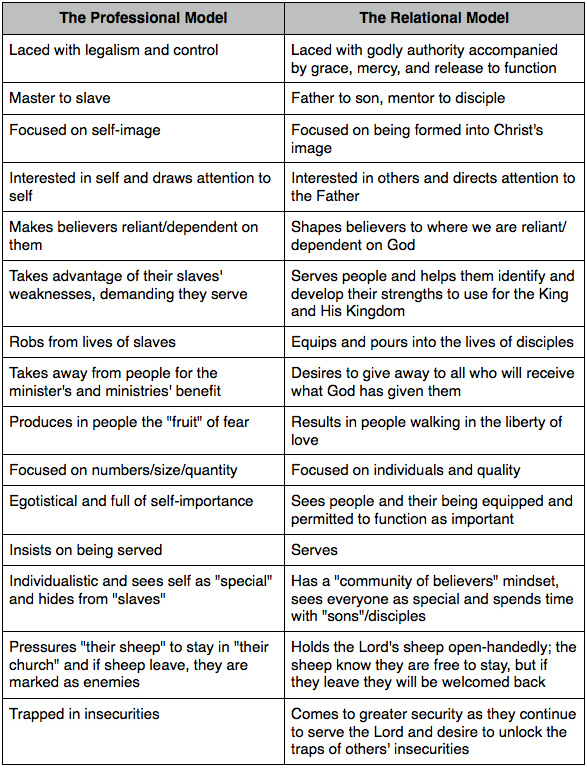

Let me make a confession: I am in a recovery program. The Lord is recovering me from one of the vilest bondages anyone can have. I am a recovering Pharisee; for a little more than seven years now, I have been coming to an increasing freedom from those ways. But more often than I like to admit, I can still see the Pharisaical ways alive in me. Professional ministry – as I lived it – is replete with Phariseeism and it is the opposite of the way Jesus ministered and Jesus is our model for ministry.

There are two kinds of ministry: professional ministry which is flesh driven and relational ministry which is Spirit-led and empowered. Our desire is that each of you consider these and position yourselves to become more relational in ministry.

Characteristics of Professional vs. Relational Ministry

Jesus’ model of ministry was relational. His disciples were ready to continue His work when He left because He had spent the majority of His time with them. He ministered to the multitudes, but He poured Himself daily into the twelve. If we are going to equip people to influence our culture, we will have to do more than give a sermon or two a week. We must regularly pour our lives and truth into the teams we are raising up.

Successfully Transitioning in Ministry by Bob Hoover

Successfully Transitioning in Ministry
Bob Hoover

Bob Hoover graduated from Rhema Bible Training Center in 1983 and pastored Living Word Church in Roberts, Illinois from 1983 through 2002. At that time, Bob and his wife Darlene moved to Decatur, IL, and served as Care Pastor at GT Church from 2002 until May of 2013. Bob and Darlene have been married since 1957 and are the parents of two daughters, three grandchildren, and two great-grandchildren.

Bob Hoover

Transitioning in MinistryIn 1983, I graduated from Rhema Bible Training Center and began pastoring in a church in my home town. I served there for approximately twenty years. In a town of 400 people, we had many challenges but saw incredible growth and had a wonderful time.


It took some time to see the congregation grab hold of the vision that God had given me. The church started before my wife and I had come there, and after we arrived it began to grow because of many committed people. Our Sunday morning services grew between 400-500 people, driving from an hour radius.

I didn’t get into ministry until I was in my forties, having been in business for 25 years. I believe pastoring is also a business, God’s business. When I was about 65 years old, I felt that the Lord was leading me to move closer to our children and grandchildren.

A catalyst in my decision-making was when my grandson called me and asked me if he could have just 30 minutes of my time. I realized that I had been so busy in ministry that my own grandson was requesting to have time with me. I didn’t want to let that season of life pass me by without having a strong and closer relationship with my grandchildren.

In 2002, we moved to a larger city where our daughter and son-in-law pastored. My son-in-law asked if I would be a pastor on his staff because a pastor was moving away. I took the job being fully aware that things would be different from being the lead pastor to just one of nine pastors on staff.

My job was well-defined. I was to be the Care Pastor. I wold make hospital calls, visit shut-ins, be the main Spiritual Guidance Counselor, and teach the congregation of adults on Wednesday nights.

It worked well for me, except I felt that the pastoral staff had a hard time receiving any suggestions that I may have had. I think that they felt things were done differently in a larger city. At staff meetings, I hardly said a word. I knew this would be a humbling experience. I think it was probably really good for me, even though I felt that I had the experience to give sound advice.

I got along very well with the congregation and they showed so much love for us. When some people passed away, some of the staff were amazed that I was asked to do their funerals.

The thing that they did not understand was that I was the one who was with those people during their last days. My job was enjoyable and the congregation was great, but the staff was not accepting of me. After I retired, several people from the congregation said that the pastoral staff saw me as a threat. This really surprised me.

In March of 2013, my wife had two heart attacks. So on May 2, when I turned 75 years old, I stepped down from the staff. I still have been doing some funerals when I am asked. I was raised in a family of eight children and was taught that if you are not working that you are lazy. The retirement life has been a big adjustment, and at times, I feel guilty for not working. It has brought my wife and I closer than ever.

I am not sure if I have been successful in making these changes. I was so pleased with the first church I pastored, but there is no turning back and the Lord is helping us each and every day by His precious Holy Spirit.

P.S. I mentioned wanting to spend time with my grandchildren was a catalyst in my decision to leave my role as senior pastor. When I became Care Pastor at the church in Decatur, I would often take my grandchildren with me on visits. My grandson is now in ministry. When we were visiting at hospitals and had to wait to see a patient, my granddaughter would often pick up medical magazines and read them. She is now in training to be a Physician’s Assistant. Our other granddaughter is on staff at the church in Decature.