
Mastering the Paradoxes of Ministry Tony Cooke
Mastering the Paradoxes of Ministry
Tony Cooke
 A paradox involves the presentation of two ideas which seem to be contradictory, but are in fact, complementary. A few classic examples in Scripture of paradoxical statements are:
- “…when I am weak, then I am strong” (2 Corinthians 12:10)
- We are in the world, but we are not of the world (John 17:11, 14)
- “I am crucified with Christ; nevertheless I live; yet not I, but Christ liveth in me…” (Galatians 2:20)
In his classic, “Make Me an Instrument,” Francis of Assisi captured the essence of paradox when he prayed: “…for it is in giving that we receive, it is in pardoning that we are pardoned, it is in dying that we awake to eternal life.”
Richard B. Hansenis said, “Paradox is the wild territory within which most ministers live and work. We see unseen things. We conquer by yielding. We find rest under a yoke. We reign by serving. We are made great by becoming small. We are exalted when we are humble. We become wise by being fools for Christ’s sake. We are made free by becoming bondservants. We gain strength when we are weak. We triumph through defeat. We find victory by glorying in our infirmities. We live by dying.”
Parádoxos is a word common in secular Greek for “an unusual event contrary to belief or expectation.” Its only use in the New Testament is in Luke 5:26: “And they were all amazed, and they glorified God and were filled with fear, saying, "We have seen strange [parádoxos] things today!”
The word here literally means “things which are contrary to opinion, expectation, or belief.” The Amplified Bible renders this, “We have seen wonderful and strange and incredible and unthinkable things today!” Does that seem like a pretty good description of ministry? Sometimes it’s wonderful. Sometimes it’s strange. Sometimes it’s incredible. Sometimes it’s unthinkable.
God’s kingdom is full of paradoxes. We might like to only deal with one end of the spectrum (the good side), but those who survive and thrive are those who learn to deal effectively with all aspects of ministry. We recognize that serving God offers us many “both/and” scenarios… not just “either/or” situations. Consider these statements by the Apostle Paul that reflect paradox.
2 Corinthians 6:8-10
8 by honor and dishonor, by evil report and good report; as deceivers, and yet true; 9 as unknown, and yet well known; as dying, and behold we live; as chastened, and yet not killed; 10 as sorrowful, yet always rejoicing; as poor, yet making many rich; as having nothing, and yet possessing all things.
2 Corinthians 4:8-11
8 We are hard-pressed on every side, yet not crushed; we are perplexed, but not in despair; 9 persecuted, but not forsaken; struck down, but not destroyed — 10 always carrying about in the body the dying of the Lord Jesus, that the life of Jesus also may be manifested in our body. 11 For we who live are always delivered to death for Jesus’ sake, that the life of Jesus also may be manifested in our mortal flesh.
How many seemingly conflicting and contradictory statements can someone make in one letter? How many seemingly conflicting and contradictory emotions can one minister experience in one season of life? In a Peanuts comic strip, Charlie Brown tells Lucy the universal axiom, “Life has its ups and downs.” Lucy is seen screaming in the last box, “I don’t want downs. I want ups, ups, and more ups. The truth is that life involves learning to deal with the good and the bad, and ministry involves a broad spectrum of experiences as well.
Jesus not only got, “Blessed is he who comes in the name of the Lord,” He also got “Crucify him, crucify him!” Ministers need to know how to deal with both criticism and praise—with the ups and the downs. In Acts 14:18, Paul is barely able to keep the multitude from offering sacrifices to him and Barnabas as gods. In Acts 14:19, one verse later, the same multitude is stoning Paul and dragging him out of the city, assuming that they’ve killed him.
Perhaps what we experience—going from one end of the spectrum to the other—isn’t quite as drastic as what Paul experienced, but many ministers know what it is:
- To go from the funeral home to the wedding rehearsal. You weep with those that weep and you rejoice with those that rejoice.
- To be overwhelmed by the amazing love and kindness of a church member one day, and feel the sting of betrayal by someone else the next day.
- To have someone tell you how grateful they are for your ministry and share how their life has been totally changed, only to be followed by a meeting with someone else who is telling you that they’re leaving your church.
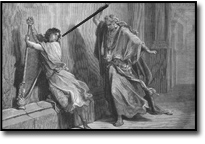
Paul dealt with these paradoxes—these seemingly contradictory situations—and so did David. David had the most wonderful relationship imaginable with Jonathan. He also had the most horrible relationship imaginable with Saul. 1 Samuel 18:3, we read that, “Jonathan and David made a covenant, because he loved him as his own soul.” In verse 11, just a few verses later, Saul is throwing a spear at David, saying, “I will pin David to the wall!” David’s experience could have been the inspiration for the opening statement of “A Tale of Two Cities:” “It was the best of times. It was the worst of times.”
The question is: Can we get our mind and our emotions around these circumstances and these dynamics without being pulled apart by them?
- Pilots have to deal with crosswinds and wind shear.
- Swimmers have to deal with riptides and undertow.
- Ministers have to deal with paradoxes—these situations that seemingly pull us in different directions.
Have you ever considered the fact that Proverbs 26:4-5 (NLT) seems to give us completely contradictory instructions? “Don’t answer the foolish arguments of fools, or you will become as foolish as they are. Be sure to answer the foolish arguments of fools, or they will become wise in their own estimation.” So how is a believer supposed to know what to do when encountering foolishness? Do we ignore it or address it? I think this Scripture indicates that there is a time for both, and we must have wisdom and direction from the Holy Spirit to know which is an appropriate response in a given situation.
A lot of what we’ve mentioned so far is situational and relational. But we also deal with paradoxes theologically. Theological paradoxes are often those issues where people take one side of an issue and exalt it to the neglect of another issue. They take two issues that both involve truth, but instead of realizing the complementary nature of these issues, they perceive them as somehow being contradictory and exclusive.
- There is something true about the sovereignty of God, and there is something true about human responsibility (the free will of man). It’s not an either/or… it is a both/and.
- Some hold to an emphasis on an unchanging God, while others herald the power of prevailing prayer. There is truth in both concepts.
- What about the transcendence and the imminence of God? The God who dwells in eternity and the God who is present with us right now? They are the same God.
- Is God Three, or is God One? There is truth regarding the Trinity of God, and there is also truth regarding the Unity of God.
- Is Jesus human or is Jesus divine? It’s not an “either/or.” It’s a “both/and.”
- Romans 11:22 says, “Therefore consider the goodness and severity of God…”
- In 2 Corinthians, Paul referred both to “the Father of mercies and God of all comfort,” but also to “the terror of the Lord” (1:3 and 5:11).
- Hebrews 4:11 says, “Let us labor therefore to enter into that rest…”
- What about the paradox of faith and works?
- We are not saved by works, but we are saved “unto good works” (Ephesians 2:9-10).
- We are to “Study to show ourselves approved unto God,” but we must not “lean to our own understanding” (2 Timothy 2:15 and Proverbs 3:5).
- A man who surrenders himself over to the Lordship of Jesus—who becomes a bond-slave of Christ—experiences absolute liberty and freedom, while a man who insists on being free from the rule of God wears a ball and chain throughout his life.
All of these are paradoxical ideas, and we’ll always be lacking if we think we have to choose either/or when it comes to the great truths of Scripture. Many times, we feel a tension between these truths…yet with God, we know that He holds all of these things in perfect harmony. Hansenis said, “Paradox beckons us into Mystery, and offers a wholesome reminder that God is infinitely greater than our ideas about God.”
May we receive great wisdom from God to walk skillfully in His paths!
 For the past several months, I have been reading the Old Testament slowly and systematically, and it has done my soul good. I have always majored on the New Testament, and I’m sure that this will always be the case; after all, that is OUR Covenant. But there has been something very rich and meaningful that I’ve been enjoying in mulling over God’s dealings with humanity prior to the coming of Jesus.
 There is a great lesson for us in understanding the formation of pearls. Natural pearls are formed when a grain of sand or another object slips in between one of the two shells of the oyster. Because of the irritating nature of the sand, the oyster encapsulates it in layers of “mother of pearl” secretion, and the pearl grows in size as the number of layers increases and the iridescent gem is formed.
 Perhaps you’ve heard about the little boy who was given an orange by a man. The boy’s mother asked, “What do you say to the nice man?” The little boy thought for a second, handed the orange back, and said, “Peel it.” There’s a little bit of gratitude lacking there, wouldn’t you say?
 Many years ago at a church service, I gave an altar call and a handful of people responded; one of these being a boy in his early teens. I had a self-congratulatory thought as though I was somehow responsible for these responses. Reality came quickly as a dear lady approached and let me know how thankful she was that God had touched her grandson’s heart. This grandmother told me that she had been praying for years for her grandson to come to the Lord. I realized that “I” wasn’t the cause of this young man coming to the Lord at all. I had been privileged to have a role in the overall process, but the gospel, the Power of the Holy Spirit, and this lady’s prayers were the major components of the process that led to this glorious event.
 I remember a decades-old television commercial from Memorex, a company that made cassette tapes. A glass was shown sitting on a table while the voice of Ella Fitzgerald was heard singing. When a certain high note was hit, the glass shattered and the viewer was asked, “Is it live, or is it Memorex?” The point is that the quality of their product was so high that taped recordings were essentially indistinguishable from the live voice.
 There are two types of limitations. There are legitimate limitations that we should respect, and there are perceived limitations that we should transcend. Wisdom in life is knowing which limitations are valid and are to be respected, and which limitations are illusions that are meant to be conquered.

 I’m curious. Who has defined reality for you? What is the basis for how you see yourself, the people around you, your circumstances, your destiny, and your world? How much of your sense of reality has been defined by your parents, your education, society, and the media?
  Jealousy is often thought of only in a negative light, and there has been no shortage of negative examples to reinforce such thinking. In its negative expression, ungodly jealousy is a carnal, ugly trait associated with insecurity, fear, covetousness, and suspicion. It was Shakespeare who called jealousy a “green-eyed monster.”
 John F. Kennedy is a great figure in American history, and is well-known as our thirty-fifth president. After graduating from Harvard in 1940, he entered the Navy and was put in charge of a U.S. Navy Torpedo Boat, PT-109, in the Pacific. When he and his crew were on a night patrol in August of 1943, their boat was rammed by the Japanese destroyer, Amagiri. Kennedy (who had been injured himself) towed a more seriously wounded man as he led the survivors to safety by swimming to a nearby island. Five difficult days afterward they were rescued.
 There wasn’t anyone who seemed to be better “kingly material” than Saul. Scripture tells us, “…There was not a more handsome person than he among the children of Israel. From his shoulders upward he was taller than any of the people” (1 Samuel 9:2).
 In her youth, mom was very athletic. She played softball, tennis, and basketball competitively, and was a Physical Education major at Hanover College in Madison, Indiana. She held the record in discus there for some time. Her studies at Hanover were cut short because of Rheumatic Fever, and the doctors told her mother that she would only live for four or five more years. Mom always took pride in being strong, and even in her mid-80’s as she was recovering from injuries sustained in the car accident that took my dad’s life, she periodically would challenge her doctors to an arm-wrestling match.
 If you are my age or a bit older, you may remember the hysteria surrounding the Beatles when they first became popular. In addition to “Let it Be” and “I Want to Hold Your Hand,” you may recall teenybopper fans who were beside themselves, screaming, crying, and swooning in their presence.
 Before addressing this, it is vital to define our terms scripturally. The words “repent” and “repentance” do not mean that we anxiously wallow in guilt, hashing and re-hashing our failures, or that we walk perpetually in sin-consciousness. Here is what some of the most respected Greek scholars have to say about the Greek word for repentance:
  "God’s work done in God’s way will never lack God’s supply."
 The Apostle Paul used athletic imagery on occasion to emphasize certain aspects of the Christian life and of ministry work. I’ve enjoyed seeing the many parallels that exist when it comes to those who excel and become true champions in their given fields, whether it’s in the natural arena of sports or the spiritual field of ministry and working for God.
 As I travel, I’m hearing more and more thought that is circulating in the Body of Christ regarding an “understanding” of grace that seems to be facilitating and promoting a sense of irresponsibility in people. Some applications of this would include: